
Forex Major Currencies Outlook (June 15 – June 19, 2026)
Week Ahead Summary
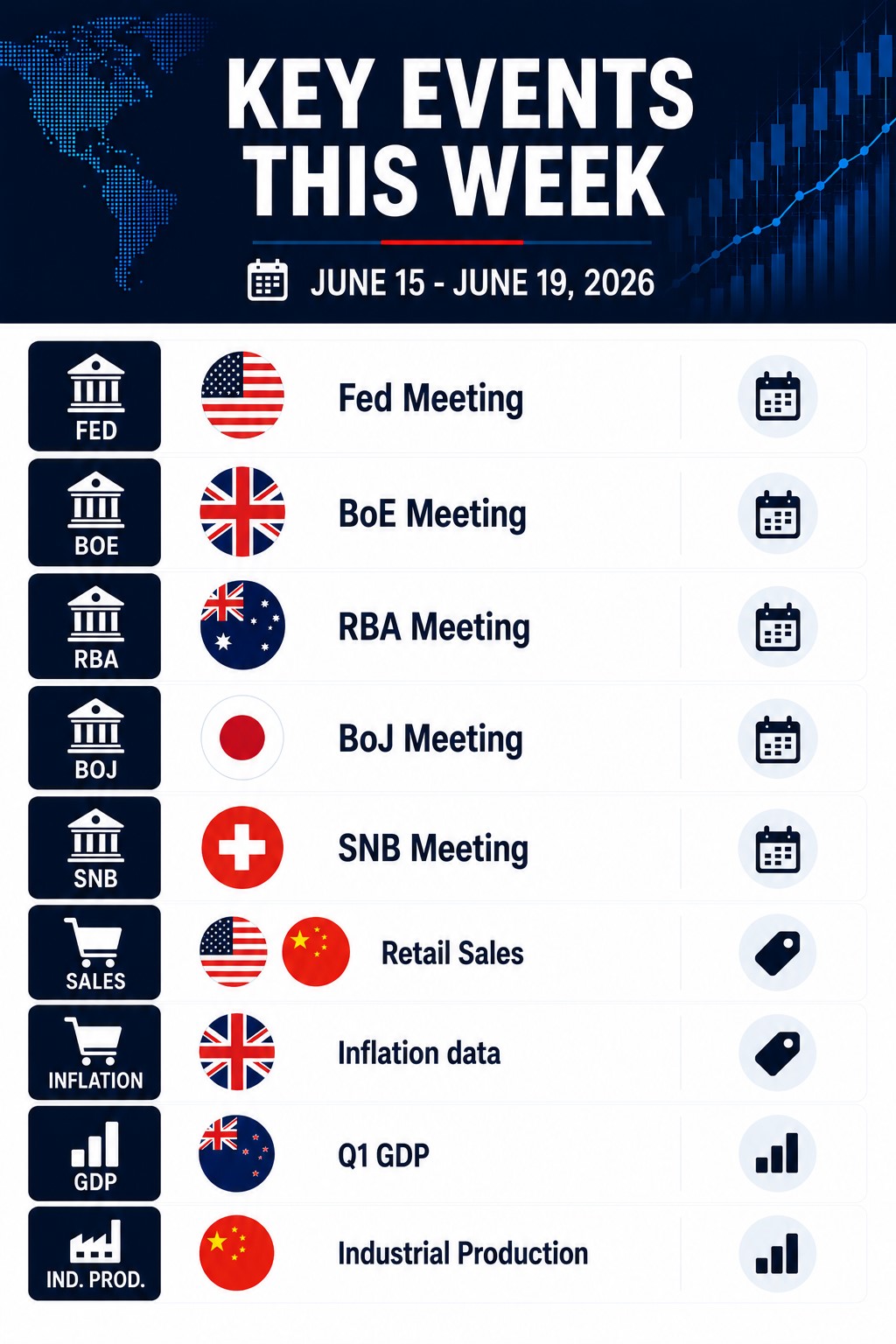
Central bank bonanza with Fed, BoE, RBA, BoJ and SNB meetings will be followed by retail sales from the US, inflation from UK, Q1 GDP from New Zealand as well as economic activity data from China.
USD — US Dollar
Iran and Israel have attacked each other with Iran directly blaming US for the breach of ceasefire only to later on Monday announce end of military operations against Israel. During the week Iran has downed US Apache helicopter over the Straight of Hormuz. The US retaliated by attacking Iranian military facilities only for IRGC to to retaliate in response to that and attack US military bases in Kuwait, Bahrain and Jordan. All of this did not manage to move oil higher as it quickly fell below $90 and stayed there. Then Trump amped his rhetoric expressing his dissatisfaction about the way negotiations continue to drag on and stated that Iran must “pay the price” threatening attacks on power plants and bridges. This managed to lift oil above $90. After just several hours he called off those attacks stating “We ended the war with Iran today” and markets went into a risk on mode with oil falling as low as $85 while equities rallied. There was a talk of another peace deal with Iran agreeing to almost all parts only for Trump to report that it is fake news. Finally, on Friday a new 60-day ceasefire has been brokered between parties.
May inflation report came in line with expectations with headline number at 4.2% y/y, up from 3.8% y/y in April and core at 2.9% y/y, a tick up from 2.8% y/y the previous month. Unrounded headline came in at 4.248% y/y, so on the cusp of 4.3% y/y while unrounded core was at 2.8509%, on the cusp of 2.8% y/y. Headline monthly figure came in at 0.5%, as expected and 0.473% m/m unrouded, but core print came in at 0.2%, 0.208% m/m unrounded, lower than 0.3% as expected and down from 0.4% in April. Energy prices were the main culprit for increase in inflation with fuel oil prices rising 58.9% y/y and gasoline recording biggest monthly increase of 7% while food inflation eased. The biggest component of inflation, shelter, came in at 0.3% m/m, down from 0.6% m/m in April and 3.4% y/y. Supercore CPI 0.1196 m/m and 2.43% y/y. Services less energy services saw prices increase by 0.3% m/m vs 0.5% the previous month and 3.4% y/y. Fed can breathe a sigh of relief as there are no signs of energy shocks spilling over to the other parts of the economy. PPI surged to 6.5% y/y from downwardly revised 5.7% in April, coming in higher than 6.4% y/y as expected. SpaceX IPO was a success and it made Elon Musk first trillionaire, that is 1000 billions.
The yield on a 10y Treasury started the week at 4.52%, rose to 4.59% and finished the week at around 4.48%. The yield on 2y Treasury started the week at 4.15%, rose to 4.21% and finished the week at around 4.09%. Spread between 2y and 10y Treasuries started the week at 39bp and finished the week at 39bp. FedWatchTool sees the probability of a 25bp rate cut at June meeting at around 2% while probability of no change is at around 98%. WTI prices have declined on expectations for a peace deal and finished the week around $85. Gold has dropped below March low and got dangerously close to the $4000 level before bouncing towards $4200 on hopes for a peace deal.
This week we will have retail sales and FOMC meeting. This will be the first meeting under new Chairman Kevin Warsh so it should have bigger-than-usual effect on the markets. There will be no change to rate but markets will have a chance to see how new Fed will tackle issues ahead. Warsh mentioned several times that he is not in favour of forward guidance so this may be the last SEP we get in a while.
Important news for USD:
Wednesday:
-
Fed Interest Rate Decision
-
Retail Sales
EUR — Euro
ECB has delivered a 25bp rate hike to all three of their rates as expected lifting the deposit rate to 2.25%. This is the first rate hike since September of 2023. US – Iran war is causing inflation pressures which was the main reason to lift rates up at this meeting. New ECB projections see inflation higher than projected in March with headline inflation averaging 3% in 2026, 2.3% in 2027 and 2% in 2028. Core inflation is seen at averaging 2.5% in 2026 and 2027 as well as 2.2% in 2028. Growth projections have been revised down and GDP is now seen averaging 0.8% in 2026, 1.2% in 2027 and 1.5% in 2028. Members have characterized risks as upside to inflation and downside to economic growth. They will continue monitoring situation, taking data-dependent and meeting-by-meeting approach as well as deciding to not pre-commit to any rate path.
ECB President Lagarde reiterated at the press conference that risks to growth are tilted to the downside while risks to inflation are tilted to the upside but she downplayed the former risks while emphasizing the latter risks. She has highlighted several times that this is not just an “insurance” hike and added that although some measures of underlying inflation have increased there are no signs of second-round effects. Although ECB is not pre-committing to any rate path Lagarde has hinted that additional rate hike is likely to come.
GBP — British Pound
April GDP saw economy contract by 0.1% m/m after growing 0.3% m/m in March. The drop was led by services sector which had its output decline by 0.2% m/m. Manufacturing sector was the best performer as its output rose 0.4% m/m. Pound has enjoyed a strong week, gaining ground against all of the majors except USD.
This week we will get inflation data and will see a BoE meeting. Inflation is expected to continue to climb while we should see no change to rate with an 8-1 vote, one member voting for a hike.
Important news for GBP:
Wednesday:
- CPI
Thursday:
-
BoE Interest Rate Decision
AUD — Australian Dollar
China May trade balance showed another massive surplus of $105,43bn much stronger than $92.1bn as expected and $84.82bn in April. Exports surged 19.4% y/y while imports jumped 27.4% y/y. The report clearly shows massive foreign demand for Chinese manufacturing products with exports being pushed higher by massive rebound in exports to the US that rose 35.4% y/y. This surge in exports to the US is a result of base effects as Chinese exports to US reached the lowest point in May of last year. Surge in imports is a result of a strong domestic demand for tech products.
May inflation report saw headline number come in at 1.2% y/y, unchanged from April but a tick down from 1.3% y/y as expected. The report shows that transportation fuel prices contributed most to overall rising prices. They were balanced by the big drop in food prices, especially pork prices which plunged 16.1% y/y. Core CPI slipped to 1.1% y/y from 1.2% y/y the previous month. PPI has continued surging forward with a 3.9% y/y compared to 2.8% y/y in April as raw material prices move closed to double digit increase y/y.
This week we will have RBA meeting as well as economic activity data from China. No change in rate is expected, as RBA already hiked at three previous meetings, so markets will be focused on language and whether this will be a prolonged pause or the bank will continue hiking at their next meeting.
Important news for AUD:
Tuesday:
-
RBA Interest Rate Decision
-
Industrial Production (China)
-
Retail Sales (China)
NZD — New Zealand Dollar
Kiwi has followed the mood in the markets. It has managed to gain against other commodity currencies, AUD and CAD, but it has declined against other majors as risk off mood dominated. When Trump brought some positive rhetoric Kiwi managed to appreciate more against EUR and GBP but was not able to fully sustain those gains.
This week we will have Q1 GDP data.
Important news for NZD:
Thursday:
-
GDP
CAD — Canadian Dollar
BoC has left overnight rate unchanged at 2.25% as was widely expected. The statement shows “Recent data suggests that growth will resume in the second quarter but, even with some rebound, the economy is expected to remain in excess supply” as well as “So far, there has been limited evidence of broad-based pass-through of higher energy prices to other consumer prices.” US – Iran war and US tariff threats combined with USMCA negotiations represent sources of uncertainty. Governing Council is looking through the near-term effects on headline inflation caused by the war but they are prepared to act if those effects lead to persistent inflation.
BoC Governor Macklem stated in an opening statement that “If the United States imposes significant new trade restrictions on Canada, we may need to cut the policy rate further to support economic growth.” The alternative to that is “if the conflict in the Middle East continues and higher energy prices start leading to ongoing generalized inflation, monetary policy will have more work to do—there may be a need for consecutive increases in the policy rate.” He added at the press conference that core inflation ticked down and that economy is not clearly in recession. He does not see the need to change the course of monetary policy but is attentive to changes in environment that may spur the bank to react.
JPY — Japanese Yen
Final reading of Q1 GDP was revised down to 1.8% from 2.1% annualized as preliminary reported but it came in much stronger than expected 1.3% print. Personal consumption was unchanged at 0.3% while business investment, as suggested by last week’s CAPEX, was revised down and now showed a drop of 0.7%.
This week we will have BoJ meeting. BoJ is expected to lift rates by 25bp to 1% but the rhetoric will be of bigger importance.
Important news for JPY:
Tuesday:
-
BoJ Interest Rate Decision
CHF — Swiss Franc
SNB total sight deposits for the week ending June 5 came in at CHF469.6bn vs CHF468.6bn the previous week. One more week of negligible movements in sight deposits as SNB lets market determine Swissy’s strength.
This week we will have SNB meeting. No change to rate is expected and we will see reiteration of talk about Swissy being overvalued, their readiness to intervene in the markets and bar for negative rates being very high.
Important news for CHF:
Thursday:
-
SNB Interest Rate Decision
You can follow all economic events on the Economic Calendar page on our Website. MT server time is set to GMT+3 and if you need assistance converting MT server time to your local time you can use some of the online time converters such as WorldTimeBuddy.
Please note that this analysis should not be used as investing advice as it is only an overview of the economic events influencing the markets. Please remember that our accounts have Market Execution. Please note how Execution works during high impact news and other times of low liquidity.