
Forex Major Currencies Outlook (May 18 – May 22, 2026)
Week Ahead Summary
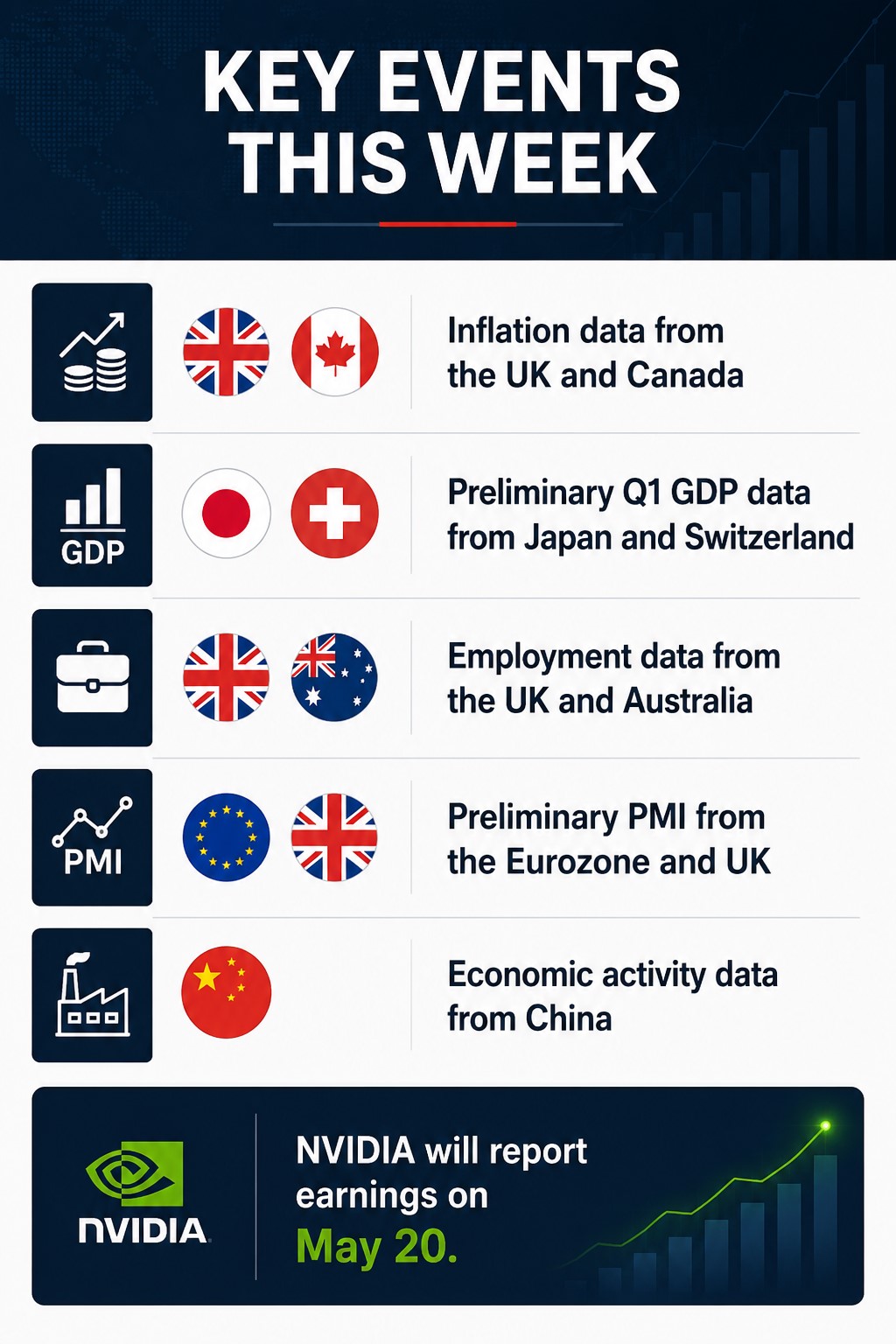
Inflation data from the UK and Canada, preliminary Q1 GDP data from Japan and Switzerland, employment data from the UK and Australia as well as preliminary PMI from the Eurozone and UK coupled with economic activity data from China will highlight the week ahead of us. NVIDIA will report earnings on May 20.
USD — US Dollar
President Trump dismissed Iran’s peace proposal as “totally unacceptable”. Media reported on May 8 that a new CIA report suggests Iran could withstand US blockade for 3-4 more months and has 70% of its missile stockpiles remaining. Additionally, Iran has regained operational access to 30 out of 33 missile sites.
Presidents Xi and Trump met in Beijing. White House official said that meeting was a constructive one as both sides discussed ways how to enhance economic cooperation. Additionally, talks were about China allowing more access to US companies and about China buying more agricultural products. On the topic of Iran both sides agreed that Straight must remain open. Chinese side pushed for more emphasis on Taiwan issue. Trump stated that their view on Iran is in concord as they both do not want Iran to get nuclear weapon. On Friday, Chinese foreign minister announced that Xi will be traveling to the US in the fall which was cheered on by the markets.
April inflation report saw headline number rise to 3.8% y/y from 3.3% y/y in March while a 3.7% y/y print was expected. The main culprit are energy prices which showed gasoline prices up 28.4% y/y while fuel oil surged 54.3% y/y. Energy services rose 5.4% y/y with electricity prices rising 6.1% y/y. Core print rose 2.8% y/y from 2.6% y/y the previous month and higher than 2.7% y/y as expected. Shelter, the biggest component of CPI, still holds above 3% and sped up with a 0.6% m/m and 3.3% y/y increase in prices. Supercore printed 0.192% m/m and 2.31% y/y. Breakevens, measuring inflation expectations, reached highest levels since October of 2022 as a result of hot CPI print. PPI came in as a shock as it printed a 6% y/y increase and a 1.4% m/m increase vs 0.5% m/m as expected.
Kevin Warsh has been confirmed as the new Fed chair by the Senate and he took over on Friday May 15. He will have trouble persuading other FOMC members that rate cuts are the way to go with CPI running close to 4% and PPI at 6% with both most likely to move higher at the May reading.
Retail sales for the month of April saw headline come in at 0.5% m/m as expected. Control group, used for GDP calculation, also came in at 0.5% m/m but stronger than 0.4% m/m as expected with March reading being revised up to 0.7% m/m. Ex autos category also beat estimates coming in at 0.6% m/m. The biggest gains were at the gasoline station, as higher gasoline prices pushed sales up 2.8% m/m and 20.9% y/y followed by gains at sporting goods, musical instruments and book stores 1.4% m/m as well as non-store retailers, online sales, with 1.1% m/m. Food services & drinking places, a good proxy for discretionary spending, showed sales increase 0.6% m/m. The biggest drop was seen in furniture and home furniture stores as they dropped 2% m/m.
The yield on a 10y Treasury started the week at 4.36%, rose to 4.62% and finished the week at around 4.59%. The yield on 2y Treasury started the week at 3.90%, rose to 4.11% and finished the week at around 4.09%. Spread between 2y and 10y Treasuries started the week at 47bp and finished the week at 48bp. The yield on a 30y Treasury stayed above 5% during the week and finished at 5.12% FedWatchTool sees the probability of a 25bp rate hike at June meeting at around 1% while probability of no change is at around 99%. WTI had another volatile week quickly rising above $100 on market open, reaching high of almost $106 and then closing above $105. S&P managed to make yet another weekly gain, despite the selloff on Friday, while NASDAQ faltered on Friday and was down for the week
EUR — Euro
Final April inflation reading from Germany was unchanged at 2.9% y/y, up from 2.7% y/y in March due to further pressures from higher energy prices. Fuel prices rose 26.2% y/y while light heating oil surged 55.1% y/y. Core CPI declined to 2.3% y/y from 2.5% y/y the previous month indicating that so far higher energy prices have not spilled over to core print. French reading was also unchanged at 2.2% y/, up from 1.7% y/y in March, Spanish reading surprised and came down to 3.2% y/y from 3.4% y/y the previous month.
This week we will get preliminary May PMI data.
Important news for EUR:
Thursday:
-
Manufacturing PMI (Eurozone, Germany, France)
-
Services PMI (Eurozone, Germany, France)
-
Composite PMI (Eurozone, Germany, France)
GBP — British Pound
BoE policymaker Megan Greene, one of the most hawkish members of MPC, stated that inflation risks are skewed to the upside but she would opt for caution and further assessment of situation caused by US – Iran war before deciding on more rate hikes. Yield on both 10y and 30y gilts reached new levels not seen since 2008 with 5.14% and 5.81% respectively. UK Prime Minister Keir Starmer stated that he intends to keep on fighting to remain at his role while some members of his party are looking to dispose of him. Andy Burnham, mayor of Manchester, and Angela Raynor are expected to challenge Starmer for the leader of Labour party.
Q1 GDP came in at 0.6% q/q as expected and 1.1% y/y vs 0.8% y/y as expected. The print was helped by a surprisingly strong March reading which showed a 0.3% m/m growth while markets were expecting a decline of 0.2% m/m. All three sectors contributed to growth in the first quarter with services sector contributing the most by growing 0.8% followed by construction 0.4% and production 0.2%. Real household consumption grew 0.6% while business investment grew 0.7% on the quarter and government consumption grew 0.4%. Net trade deducted from the GDP as imports grew faster than exports. One caveat to this strong growth is that from 2022 UK economy has a tendency to grow at a much higher rate in the first quarter of the year compared to the latter quarters of the year.
This week we will get employment, inflation and preliminary May PMI data.
Important news for GBP:
Tuesday:
-
Payrolls Change
-
Unemployment Rate
Wednesday:
-
CPI
Thursday:
-
Manufacturing PMI
-
Services PMI
-
Composite PMI
AUD — Australian Dollar
Chinese CPI for the month of April came in at 1.2% y/y vs 0.8% y/y as expected and faster price increase than 1% y/y seen in March. Higher oil prices caused by US – Iran war were the main contributor to rising inflation. Core CPI also rose 1.2% y/y indicating that there are price pressures within other categories, such as non-food inflation which rose 1.8% y/y. PPI jumped to 2.8% y/y from 0.5% y/y the previous month thus making it a new 45-month high. NBS stated that surge in PPI is due to rising prices in non-ferrous metals, oil and gas and technology equipment. April trade surplus surged to $84.82bn from $51.1bn in March as exports surged 14.1% y/y from 2.5% y/y the previous month while imports eased to 25.3% y/y from 27.8% y/y seen in March.
This week we will get employment data from Australia as well as economic activity data from China.
Important news for AUD:
Monday:
-
Industrial Production (China)
-
Retail Sales (China)
Thursday:
-
Employment Change
-
Unemployment Rate
NZD — New Zealand Dollar
RBNZ quarterly inflation expectations survey showed inflation expectations moving up as 1-year are now seen at 3.4%, up from 2.6% previously. Much more important for RBNZ policy, 2-year inflation expectations ticked up to 2.5% from 2.4% previously.
CAD — Canadian Dollar
Wholesale trade posted another strong month in March rising 1.9% m/m vs 1.4% m/m as expected while February reading was revised higher to 2.4% m/m from 2% m/m as preliminary reported. Manufacturing sales for the same month rose by healthy 3% m/m after rising 3.4% m/m in February. Housing starts jumped in April to 279.3k vs 240k as expected.
This week we will get inflation data.
Important news for CAD:
Tuesday:
-
CPI
JPY — Japanese Yen
Finance Minister Katayama met with US Treasury Secretary Bessent in Tokyo. Both sides agreed to deepen cooperation on exchange moves. Basically, there was no instruction from Washington to stop intervening in the markets. Katayama stated that Japan’s approach to currency moves was consistent with a joint statement signed with the US last September. That agreement explicitly permits foreign exchange intervention to combat excessive market volatility. She declined to comment whether there was talk about BoJ policy at the meeting so we are not sure if Bessent pushed for faster rate hikes.
March household spending plunged 2.9% y/y much worse than expected drop of 1.5% y/y. Additionally, this makes it fourth consecutive month of declines in household spending as now high energy prices add to the trend of weaker consumer. BoJ policymaker Masu stated “Japan has clearly entered an inflationary phase”, adding “therefore, what is vital from now on is to ensure that, through timely and appropriate policy rate hikes, the underlying inflation rate does not exceed 2%.” JPY failed to strengthen on such hawkish comments.
April PPI showed a surge of 4.9% y/y, smashing expectations of a 3% y/y print, due to the jump in energy prices caused by US – Iran war. Prices for petrochemicals, a key ingredient for plastics and chemical manufacturers, skyrocketed 83.2% m/m and 79.4% y/y. Such a violent shock in prices should push BoJ, that are already considering rate hikes, to deliver one at their June meeting. Additionally, yield on 10y JGB crossed 2.72% and 30y breached 4.06% level.
This week we will get preliminary Q1 GDP data.
Important news for JPY:
Tuesday:
-
GDP
CHF — Swiss Franc
SNB total sight deposits for the week ending May 8 jumped to CHF467.5bn vs CHF459.7bn the previous week. Sight deposits breached the range for the year, making new yearly high and reaching level not seen since November of last year as SNB is injecting liquidity in the markets, increasing the supply of Swissy and thus weakening it.
This week we will get preliminary Q1 GDP data.
Important news for CHF:
Monday:
-
GDP
You can follow all economic events on the Economic Calendar page on our Website. MT server time is set to GMT+3 and if you need assistance converting MT server time to your local time you can use some of the online time converters such as WorldTimeBuddy.
Please note that this analysis should not be used as investing advice as it is only an overview of the economic events influencing the markets. Please remember that our accounts have Market Execution. Please note how Execution works during high impact news and other times of low liquidity.