
Forex Major Currencies Outlook (June 8 – June 12, 2026)
Week Ahead Summary
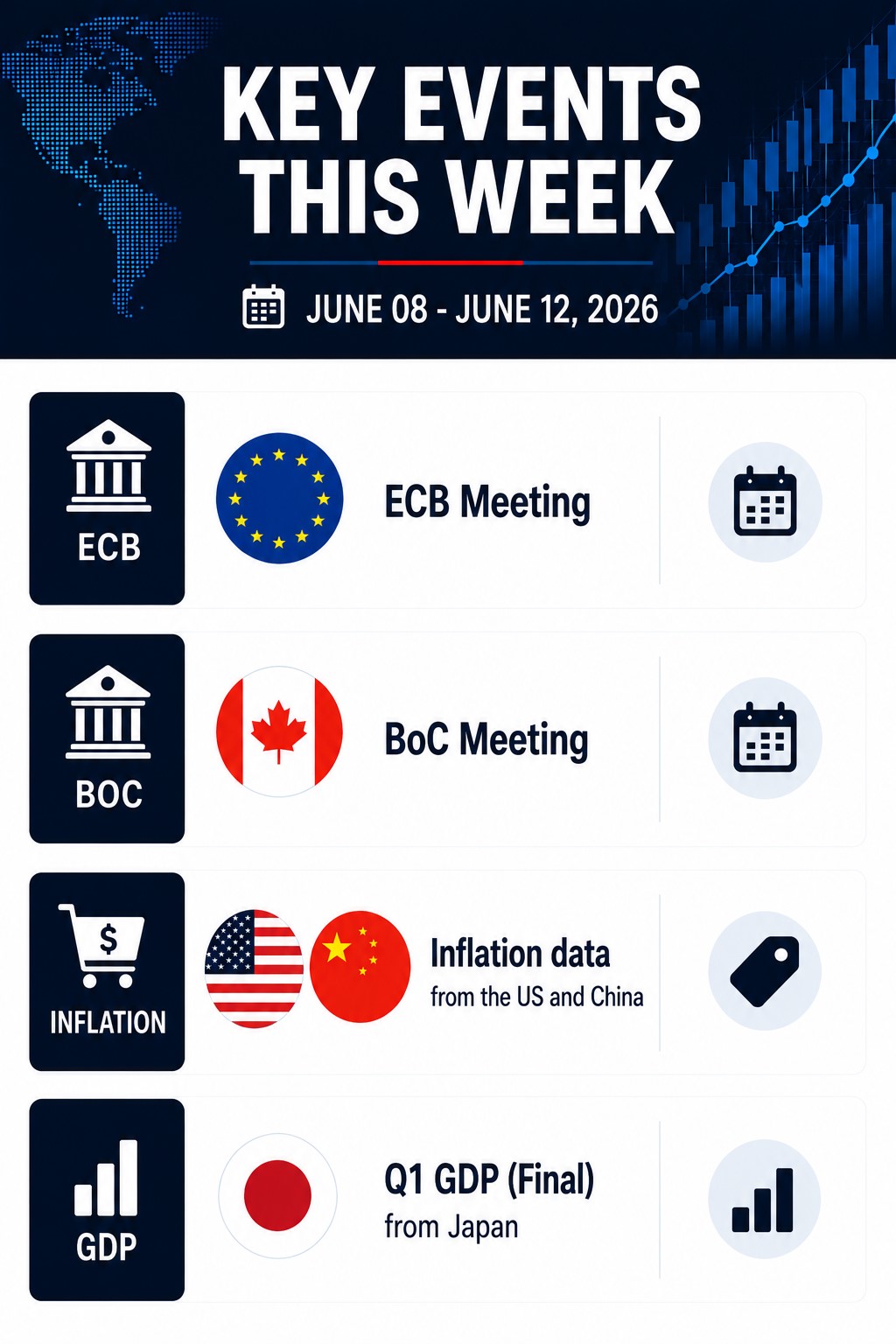
ECB and BoC meetings, inflation from the US and China as well as final Q1 GDP print from Japan will highlight the week ahead of us. Space X IPO on June 12.
USD — US Dollar
US – Iran deal is still out of reach and both sides exchanged fire over the weekend. US trade representative has recommended tariffs of at least 10% on imports from approximately 60 countries, following a Section 301 investigation into forced-labour practices with China, India, Japan, South Korea, Brazil and Switzerland facing a higher proposed rate of 12.5%.
ISM manufacturing PMI for the month of May rose to 54 from 52.7 in April. This is now the highest reading in four years. New orders rose to 56.8 while new export orders returned to expansion. Employment index improved but is still in contraction. Prices paid component eased but it is still above 80 which is staggeringly high and it yells inflationary pressures.
ISM services PMI rose to 54.5 in May from 53.6 in April beating expectations of a 53.8 print. The report shows increase in new orders and business activity while new export orders declined. Backlog of orders declined and inventories surged casting a shadow for future prints. Employment was basically unchanged and remains in contraction while prices paid component continued to rise over 70 indicating mounting inflation pressures.
May employment report saw economy add 175k jobs, more than double the 85k as expected. In addition to that the two-month net revision saw economy add 93k jobs. The unemployment rate and participation rate were stable at 4.3% and 61.8% respectively. The economy added 120k private jobs, most of it in healthcare 35k jobs. There were also 52k government jobs and 7k manufacturing jobs added. Earnings came in as expected at 0.3% m/m and 3.4% y/y. Such a strong report pushes odds of a rate hike by the end of the year.
The yield on a 10y Treasury started the week at 4.44%, rose to 4.56% and finished the week at around 4.55%. The yield on 2y Treasury started the week at 4.01%, rose to 4.18% and finished the week at around 4.17%. Spread between 2y and 10y Treasuries started the week at 44bp and finished the week at 38bp. FedWatchTool sees the probability of a 25bp rate cut at June meeting at around 4% while probability of no change is at around 96%. WTI prices have declined and finished the week around $90.
This week we will have May inflation data.
Important news for USD:
Wednesday:
-
CPI
EUR — Euro
Preliminary May inflation data saw headline CPI come in at 3.2% y/y as expected and up from 3% y/y in April. Energy prices led the increase in overall prices as they are up 10.9% y/y. Core reading printed 2.5% y/y, higher than 2.4% y/y as expected and up from 2.2% y/y the previous month as services inflation jumped to 3.5% y/y from 3% y/y in April. June rate hike is penciled in but if inflation continues to run this hot in the next month we could see July hike as well. Final Q1 GDP was revised down and it now shows that economy contracted 0.2% q/q instead of growing 0.1% q/q as reported in previous two readings.
Final manufacturing PMI for the month of May was revised up to 51.6 from 51.4 as preliminary reported but still down from 52.2 in April. The report shows that stockpiling due to supply chain disruptions caused by US – Iran war eased which caused reading to soften. Input prices surged indicating mounting inflation pressures while prices charged were also raised which suggests that costs are slowly being transferred towards consumers. Both German and French readings were revised up so the former returned to expansion while latter is on the cusp of it with a 49.7 print. Final services reading was also revised up to 47.7 from 46.4 as preliminary reported and managed to make a small gain from 47.6 in April. It was helped by positive revision to German and French readings with Italy and Spain beating expectations. New orders declined for a third straight month while inflationary pressures intensified. Composite was at 48.8 compared to 47.5 as preliminary reported.
This week we will have ECB meeting where a rate hike of 25bp is fully priced in. We will also get new staff projections and investors will look for clues on forward guidance as Lagarde could state that they are open to further hikes in the coming months.
Important news for EUR:
Thursday:
- ECB Interest Rate Decision
GBP — British Pound
May final manufacturing PMI was revised up to 53.9 from 53.7 as preliminary reported and as was in April. The report shows new orders continuing to rise but input prices are surging faster to a new four-year high. Final services PMI was also revised up and is inching closer to expansion with a 49.3 vs 47.9 as preliminary reported. This is the lowest print since April of 2025 when services were in contraction as well. The report shows marginal drop in new orders but a sharp increase in input costs. Additionally, business expectations plunge to the lowest level in over a year. BoE MPC Greene warned that the risk of acting is much less worrying that the risk of waiting. She is a hawkish member. BoE Governor Bailey took more of a dovish stance in his recent comments.
AUD — Australian Dollar
Australian economy grew by 0.3% q/q in the first quarter, slower than 0.5% q/q as expected and lower than 0.9% q/q in Q4 of 2025. Household consumption rose by 0.5% and contributed 0.3pp to the reading while government spending declined 0.2%. Growth was led by business investment in data center machinery and equipment. Net trade has deducted 0.8pp from the reading as fuel and data center related imports surged while commodity exports declined.
RBA Governor Bullock reiterated that inflation remains too high and that they expect it to increase further in near-term. She added that “Having raised the cash rate three times, monetary policy is well placed to respond to developments and the Board is focused on its mandate to deliver price stability and full employment.” This should be interpreted as they are ready to pause with rate hikes for a while.
Official PMI data for the month of May from China saw manufacturing drop to 50 from 50.3 in April due to the decline of both new orders and new export orders into contraction territory. The raw material purchase price sub-index eased to 60.5 from 63.7 the previous month indicating still very elevated inflation pressures. Non-manufacturing PMI returned to expansion with a 50.1 print and services printed 50.3. Composite was thus lifted to 50.5 from 50.1 in April. RatingDog manufacturing PMI, measuring smaller and more export oriented companies, eased to 51.8 from 52.1 but showed a smaller decline than 51.4 as expected indicating that external demand.
This week we will have May inflation data from China.
Important news for AUD:
Wednesday:
-
CPI (China)
NZD — New Zealand Dollar
Kiwi had a rough week after last week’s hawkish sounding RBNZ as risk off mood in the markets caused it to give back almost all of the gains against the majors.
CAD — Canadian Dollar
Employment report for the month of May smashed expectations. The economy added 87.8k jobs vs 10k as expected. As a result the unemployment rate dropped to 6.6% from 6.9% in April while participation rate stayed at 65%. All of the jobs added were full-time jobs (154k) while economy shed part-time jobs (66.2k). Wages rose by 3.2% y/y. Construction added 27k jobs followed by information, culture and recreation as well as transportation and warehousing both with 19k jobs added. BoC will be satisfied with this report and will mention it as a bright spot at next week’s meeting.
This week we will have BoC meeting. No change in rate is expected.
Important news for CAD:
Wednesday:
-
BoC Interest Rate Decision
JPY — Japanese Yen
Final manufacturing PMI for the month of May was unchanged at 54.5, a decline from 55.1 in April. There was strong growth in output, new orders and new export orders as stockpiling of manufacturing goods caused by US – Iran war related supply chain disruptions continues. Employment index also posted growth but so did the input costs which rose to the highest level in more than three-and-a-half years. Final services and composite readings were unchanged at 50 and 51.1 respectively, both declining from 51 and 52.2 seen in April.
Q1 CAPEX growth was flat vs 4% y/y as expected and down from 6.5% y/y in Q4. This will have negative impact on Q1 GDP and we expect a negative revision to the reading. Household spending in April declined by 0.5% y/y, showing smaller than expected 1.5% y/y decline. Wages have again surprised to the upside in April with average wages coming in at 3.5% y/y vs 3.2% y/y as expected thus growing above 3% every month in 2026. Real wages rose 1.9% y/y thus making it four consecutive months of rising real wages and giving BoJ stronger case for a rate hike this month.
This week we will have final Q1 GDP print expected to be revised down due to the weak CAPEX.
Important news for JPY:
Monday:
-
GDP
CHF — Swiss Franc
SNB total sight deposits for the week ending May 29 came in at CHF468.6bn vs CHF468.9bn the previous week. Q1 GDP came in strong with a 0.7% q/q growth, higher than 0.6% q/q as expected and much up from upwardly revised 0.2% q/q in Q4 of 2025. The report shows that industrial sector led the growth while services lagged. SNB Chairman Schlegel stated that medium-term inflation expectations are basically unchanged and warned that US – Iran war could increase pressure on Swissy. He added that their willingness to act in the FX market is increasing. CPI for the month of May came in at 0.6% y/y, unchanged from April while markets were bracing for a 0.8% y/y print. Core CPI was also unchanged at 0.3% y/y. Seasonally adjusted unemployment rate for May ticked higher to 3.1%.
You can follow all economic events on the Economic Calendar page on our Website. MT server time is set to GMT+3 and if you need assistance converting MT server time to your local time you can use some of the online time converters such as WorldTimeBuddy.
Please note that this analysis should not be used as investing advice as it is only an overview of the economic events influencing the markets. Please remember that our accounts have Market Execution. Please note how Execution works during high impact news and other times of low liquidity.