
Forex Major Currencies Outlook (June 29 – July 3, 2026)
Week Ahead Summary
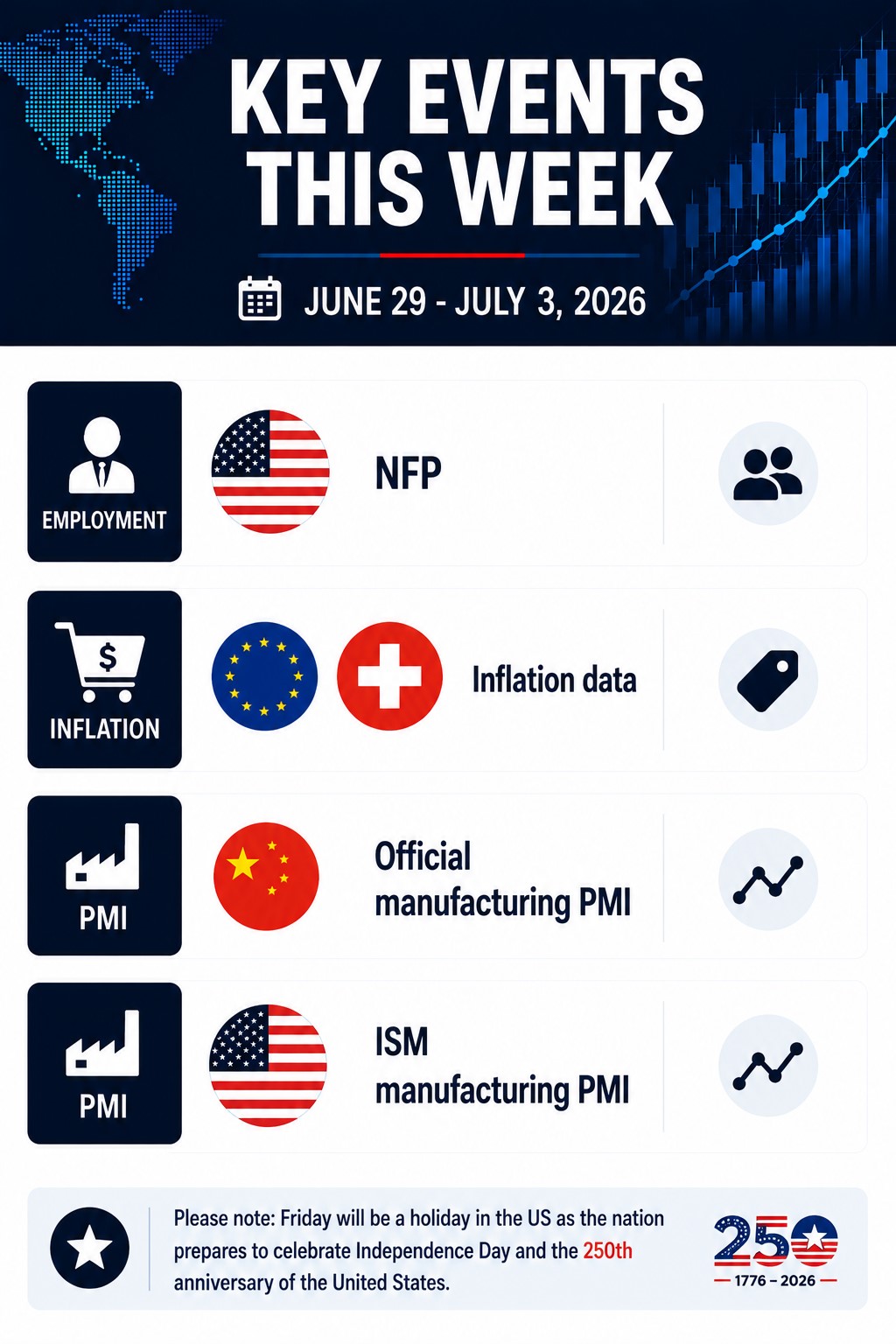
NFP, inflation data from the Eurozone and Switzerland as well as official manufacturing PMI data from China and ISM manufacturing PMI from the US will highlight the week ahead of us. Note that Friday will be holiday in the US with preparations for Independence Day and celebration of 250 years of US. This will cause liquidity to be lower in the second part of the week.
USD — US Dollar
US – Iran negotiators managed to agree to a transit mechanism which will allow for safe passage of commercial vessels through the Straight of Hormuz (SoH). Pakistani mediator announced that talks between US and Iran will continue in the week ahead of us. Iran Foreign Ministry stated that shipping through the SoH will be governed by terms of war-end memorandum with Oman.
PCE for the month of May came in line with expectations with headline printing 4.1% y/y and core 3.4% y/y, both higher than 3.8% y/y and 3.3% y/y in April. Headline PCE rose by 0.4% m/m, slightly weaker than 0.5% m/m as expected while core rose 0.3% m/m as expected, though still a tick up from 0.2% m/m the previous month. Markets felt a relief after the report, as although PCE is above 4%, inflation fears seem to be exaggerated and there will be no need for Fed to continue with such a hawkish rhetoric. Both personal income and personal spending rebounded from April and posted a 0.7% m/m growth.
Final Q1 GDP print was revised up to 2.1% from 1.6% annualized in the second reading. Business investment, mainly in data centers, did the heavy lifting with a 1.35pp contribution to the print. Government spending was at 0.74pp while consumer spending disappointed and added just 0.37pp to the reading. Consumer spending is down from 1.08pp in the advanced reading of Q1 and raises questions as consumer was the driving force of US economy for a long time. Net exports deducted 0.37pp from the GDP but with imports being revised significantly down lower negative contribution of net exports was the biggest contributor to the positive revision to the GDP. May advanced goods trade balance plunged to show a gaping $105.8bn deficit, almost 30% bigger deficit than $82.4bn seen in April as imports of goods for data centers overshadowed everything else. This will have a negative impact on Q2 GDP.
The yield on a 10y Treasury started the week at 4.46%, rose to 4.52% and finished the week at around 4.38%. The yield on 2y Treasury started the week at 4.19%, rose to 4.24% and finished the week at around 4.10%. Spread between 2y and 10y Treasuries started the week at 28bp and finished the week at 31bp. FedWatchTool sees the probability of a no change at a July meeting at around 72% while probability of a 25bp rate hike is at around 28%. WTI prices gaped higher on market open after talks that Iran has again closed SoH only to decline to around $75 after the transit mechanics has been agreed and go as low as $70. Gold briefly fell below $4000 during the week and then it hovered around that level.
This week we will have ISM manufacturing PMI as well as NFP on Thursday. Headline number is expected to come at around 90k while the unemployment rate is expected to rise to 4.5%.
Important news for USD:
Wednesday:
-
ISM Manufacturing PMI
Thursday:
-
NFP
-
Unemployment Rate
EUR — Euro
Preliminary PMI data for the month of June saw manufacturing slide to 51.3 from 51.6 in May but services improved to 48.9 from 47.7 the previous month and managed to lift composite with it to 49.5 from 48.5 in May. France managed to improve in both sectors while Germany saw a modest improvement in manufacturing but a drop in services sector. The report notes that inflation pressures eased in both sectors, as energy prices came down, but are still stronger in manufacturing as raw material and energy prices exert pressure.
ECB President Lagarde put the dovish touch on EUR as she said that there is no need to increase monetary response to the US – Iran war as her confidence grew that inflation will return to target in the medium term. ECB Chief Economist Lane stated that he sees signals of price pressures in the coming months and that high energy prices are expected to keep inflation well above target into the first half of 2027. He added that uncertainty remains high and that despite a deal being struck between US and Iran situation remains fragile. Lane sounded very hawkish and came out as a counter balance to Lagarde’s dovish comments.
ECB Executive Board member Isabel Schnabel stated that with current conditions future rate hikes will probably be needed to get inflation down to 2% target. She did not provide any timetable for future hikes, saying that it will depend on the incoming data and the situation in the Middle East but added that ECB is carefully watching second-round effects from higher energy prices. She added that although ceasefire and peace deal between US and Iran are welcome ECB should not lower its guard and should vigilantly follow price developments. Schnabel is well respected voice within ECB and her comments always lean towards the hawkish side.
This week we will have preliminary June inflation data, expected to come in unchanged.
Important news for EUR:
Wednesday:
-
CPI
GBP — British Pound
UK Prime Minister Keir Starmer announced that he will resign as Prime Minister. He will stay at his position until early September when Labour Party leadership contest will finish. Starmer faced a prospect of massive resigns from the members of his own cabinet. Nominations for new Prime Minister will begin on July 9. Mayor of Greater Manchester Andy Burnham, who recently became an MP, is the most likely replacement and new Prime Minister. Former health minister Wes Streeting announced he will not run from Prime Minister and will endorse Andy Burnham. This led to talks about Streeting becoming new Chancellor of the Exchequer. Given that he is more of a centrist figure markets cheered on and GBP strengthened.
Preliminary June PMI data did not bring good news. Manufacturing slipped to 53.1 from 53.9 in May while services turned deeper into expansion with 48.7 vs 49.3 the previous month. Markets were expecting services to return to expansion with a 50.1 print. Composite was dragged down to 49.3 from 49.7 in May. The report indicates that economy was flat in Q2 additionally stating that price pressures remain elevated due to energy shock and supply disruptions which in turn has negative effect on employment which is now falling at an alarmingly high rate.
BoE MPC Alan Taylor stated that according to him the decision to hold bank rate unchanged at June meeting was appropriate given the circumstances. He added that bank rate is 75bp above the level he sees as neutral and warned that energy shock caught them with a “very week economy.”
AUD — Australian Dollar
May monthly CPI saw headline ease to 4% y/y from 4.2% y/y seen in April while markets were expecting it to tick up to 4.3% y/y. Government actions to reduce fuel prices were the main reason inflation did not move higher. Trimmed mean, core CPI, moved up to 3.6% y/y from 3.4% y/y the previous month. This mixed report will not make RBA’s job any easier. They will welcome a small decline in headline number but pick up in core number shows that underlying price pressures remain and could indicate that second-round effects from higher energy prices are starting to show up. RBA policymaker Hauser stated that inflation remains far too high and that they have more work to do to bring it down to their targeted range of 2-3%.
Employment report for the month of May was mixed with job composition pulling towards a dovish side. The economy added 40.3k jobs, more than 30.3k jobs as expected but April reading was revised down and is now showing bigger job losses on the month (-40.7k from -18.6k). The unemployment rate ticked down to 4.4% while participation rate stayed unchanged at 66.7%. The economy added 5.2k full-time jobs and 35.2k part-time jobs. Hours worked dropped by 1.1% pushing this report more to the dovish side. Household spending rose 1.3% m/m, higher than 0.5% m/m as expected and reversed a -1.1% m/m drop in April. This report will not sway RBA towards rate hikes. They will have one more inflation and employment report before they make their decision at August meeting.
This week we will have official PMI data from China.
Important news for AUD:
Tuesday:
-
Manufacturing PMI (China)
-
Non-Manufacturing PMI (China)
-
Composite PMI (China)
NZD — New Zealand Dollar
Kiwi has had another abysmal week as risk off mood in the markets had it falling against all the major currency pairs, most notably EUR and GBP, except against AUD where it managed to gain some ground on the back of clear monetary policy divergence between two central banks.
CAD — Canadian Dollar
May inflation data saw headline CPI rise to 3.2% y/y from 2.8% y/y in April, higher than 3% y/y as expected. Gasoline prices were the main culprit for price increases as they rose 2.3% m/m and 33.2% y/y. Headline CPI rose 1% m/m. Air transport prices showed the first signs of second-round effects from higher oil prices as they rose 7.4% y/y, Core measures saw median and trim unchanged at 2.1% and 2% respectively while common CPI rose 2.7% y/y from 2.5% y/y in April. BoC is on a prolonged pause regarding rates and given the fact that oil prices are coming down we see them describing this inflationary jump as transitory and staying on their path.
JPY — Japanese Yen
BoJ Deputy Governor Ryozo Himino spoke in front of the Diet and emphasized risks of inflation overshooting. He warned that if necessary adjustments to monetary policy are delayed it could cause prices to overshoot targets. He clarified that recent high oil prices transferred to other consumer goods much faster than anticipated. Himino sees that easy financial and monetary conditions will remain for the time being. In a quick response to his hawkish remarks Prime Minister Takaichi urged for restraint in policy. Her request is viewed as a direct signal that government would prefer for rates to remain unchanged. This in turn will complicate BoJs decisions further as they will have to balance economic activity with government’s desires.
Preliminary June PMI data showed manufacturing rise to 54.9 from 54.5 in May. New orders posted a strong growth caused partly by inventory building as clients frontload amid supply disruptions and expected price increases. Wages in manufacturing sector rose at the highest pace in over eight years, a sign that will not go unnoticed by the BoJ. On the other hand, input costs surged to a new four year high as prices of energy and raw materials are rising rapidly due to the supply disruptions caused by the US – Iran war. Inflationary pressures are mounting. Services rose to 51.8 from 50 the previous month and managed to lift composite to 52.5 from 51.1 in May.
BoJ policymaker Tamura, the most hawkish member, stated that he sees 2% as neutral rate and thinks that rates should be increased every few months in order to get to neutral. He also believes in faster balance sheet reduction and dissented at last meeting’s decision to pause with taper of JGBs. According to Tamura Japan has already achieved 2% inflation target and it is necessary to hike rates now in order to avoid inflation overshooting above the target.
June CPI data for the Tokyo area saw acceleration in the data. Headline number rose 1.7% y/y, up from 1.4% y/y in May. Core print showed increase in prices of 1.6% y/y from 1.3% y/y the previous month making it thus the first increase in core, ex fresh food, in eighth months. Core-core, ex fresh food and energy, rose 1.9% y/y, up from 1.6% y/y in May and higher than 1.8% y/y as expected. Headline number was kept down by government subsidies but increase in core readings suggests presence of second-round effects. BoJ will not be happy with this inflation dynamics and talks about another rate hike in October are ramping up.
CHF — Swiss Franc
SNB total sight deposits for the week ending June 19 came in at CHF471.9bn vs CHF468.5bn the previous week. This is the highest sight deposits were in 2026 and these levels have not been reached since mid-October. The reading indicates that SNB is selling CHF into the market thus raising its liquidity and putting a lid on its strength. SNB policymaker Tschudin stated that medium-term inflation expectations are unchanged and reiterated bank’s willingness to intervene in the FX market.
This week we will have June inflation data expected to show small increase in prices.
Important news for CHF:
Thursday:
-
CPI
You can follow all economic events on the Economic Calendar page on our Website. MT server time is set to GMT+3 and if you need assistance converting MT server time to your local time you can use some of the online time converters such as WorldTimeBuddy.
Please note that this analysis should not be used as investing advice as it is only an overview of the economic events influencing the markets. Please remember that our accounts have Market Execution. Please note how Execution works during high impact news and other times of low liquidity.