
Forex Major Currencies Outlook (July 6 – July 10, 2026)
Week Ahead Summary
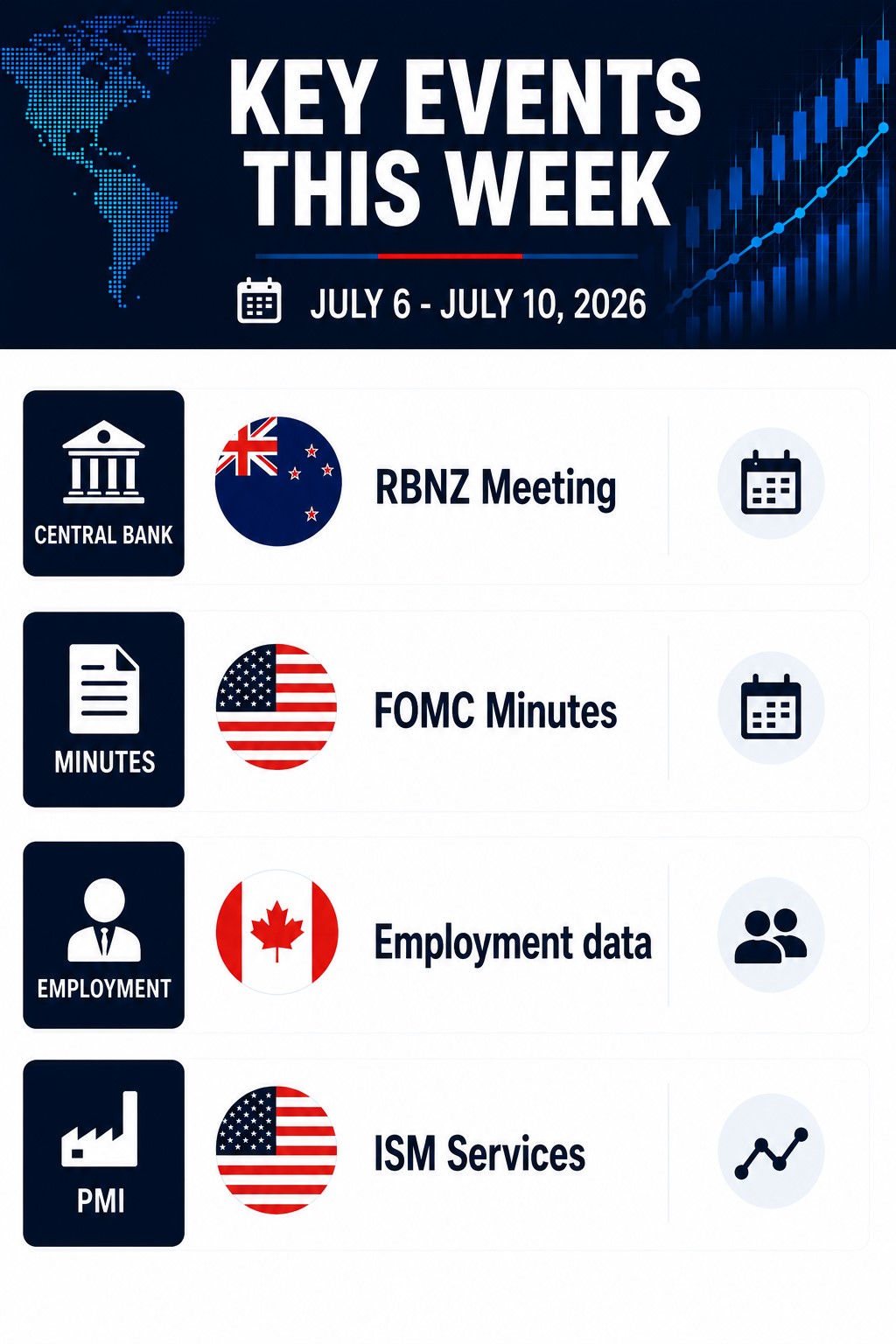
RBNZ meeting, FOMC minutes, employment data from Canada and ISM services will highlight the week ahead of us.
USD — US Dollar
Over the weekend Iran has fired missiles towards US bases in Kuwait as well as struck a commercial vessel in the Straight of Hormuz (SoH). Tensions have calm down as the trading week started and both sides are now looking towards continuation of peace talks in Doha. Wall Street Journal reported, citing US officials, that Trump is weighing an option for an all-out war with Iran as there are talks about resuming full-scale strikes on Iran. Trump is choosing diplomacy at the moment and has told his negotiators that he would be fine if nuclear talks extended past August 18 deadline. Negotiations in Doha ended with no visible breakthrough while mediators state that talks were productive. Next round of negotiations should begin next week.
ISM manufacturing PMI for the month of June came in at 53.3 down from 54 as expected and in May. The report shows new orders and production indexes easing but still safely in expansion and employment index getting closer to expansion with a 49.7 reading. Prices paid dropped by more than expected now printing in low 70s, still very elevated but much better than 82.1 seen the previous month. New export orders returned to contraction as foreign demand disappointed.
Speaking at the ECB forum in Sintra Fed Chairman Warsh stated that inflation expectations are moderating and that five task forces that should be formed by the end of the year could change economic data the Fed focuses on. He added that interest rates should be the dominant means through which Fed makes monetary policy.
June employment report saw economy add 57k vs 110k jobs as expected. The unemployment rate ticked down to 4.2% as participation rate plunged to 61.5% from 61.8% in May meaning that more than 700 000 people left workforce. May reading showed negative revision of 43k jobs. Average hourly earnings rose 0.3% m/m, same as previous month, and 3.5% y/y, a tick higher from 3.4% y/y in May. Private added 49k jobs while 8k jobs were added by the government. Private education and healthcare added 69k jobs while leisure and hospitality lost 61k jobs which is particularly strange given that World Cup is going on in the US. Perhaps those jobs will appear in July report. Combination of weak jobs report and more dovish sounding Warsh significantly lowers chances of a July rate hike.
The yield on a 10y Treasury started the week at 4.37%, rose to 4.50% and finished the week at around 4.49%. The yield on 2y Treasury started the week at 4.10%, rose to 4.20% and finished the week at around 4.19%. Spread between 2y and 10y Treasuries started the week at 28bp and finished the week at 35bp. FedWatchTool sees the probability of a no change at a July meeting at around 82% while probability of a 25bp rate hike is at around 18%. WTI prices started the week at around $70 and finished the week below it. Gold briefly fell below $4000 at the start of the week but then rebounded and finished the week at around $4170.
This week we will get June ISM services as well as minutes from the latest FOMC meeting, the first meeting chaired by the new Fed chairman Kevin Warsh.
Important news for USD:
Monday:
-
ISM Services
Wednesday:
-
FOMC Minutes
EUR — Euro
ECB Executive Board member Isabel Schnabel reiterated her hawkish stance over the weekend. She stated that ECB should deliver more rate hikes despite the oil prices coming down due to SoH reopening. Schnabel said that reopening will be gradual and that higher oil prices are already passing through thus creating second-round effects and lifting inflation up. She is perhaps the most hawkish member of Execute Board so her comments are in line with her usual tone. ECB Chief Economist Lane acknowledged that there has been some improvement in confidence but warned that oil curve show higher expected oil prices in the coming years which will put inflationary pressures on the economy. ECB policy maker and president of German Bundesbank Nagel stated at the ECB conference in Sintra that inflation will stay significantly above the target but that it is still too early to make calls on future rate hikes. Given that he is a well-known hawk this “dovish” sounding message will have implications on EUR and may provide obstacles to a July hike.
Preliminary June inflation fore Eurozone saw headline number decline to 2.8% y/y from 3.2% y/y in May while markets were bracing for a 3% y/y print. Core inflation came in at 2.4% y/y, down from 2.6% y/y the previous month and lower than 2.5% y/y as expected. Energy, food and services inflation all came down as inflation declined 0.1% m/m. German inflation declined to 2.3% y/y from 2.6% y/y in May while core print stayed unchanged at 2.5% y/y. Monthly inflation showed second month of price declines with a 0.3% print. French inflation dropped to 1.8% y/y from 2.4% y/y in May, printing below targeted 2% and much lower than 2.1% y/y as markets expected with monthly number showing a 0.2% decline. Italian reading was lower as it printed 3% y/y, down from 3.2% y/y in May. Spanish inflation was unchanged at 3.2% y/y while markets expected a slowdown to 3% y/y while core inflation ticked down to 2.9% y/y from 3% y/y in May.
Final manufacturing PMI for the month of June was revised up to 51.4 from 51.3 as preliminary reported on the back of positive revision to French reading. German reading was revised down but they still both stay in expansion. Output and new orders improved while new export orders declined. Regarding inflationary pressures the report states “The rate of input cost inflation, albeit still elevated, declined in June and was its softest since March.” Final services were revised up to 49.4 on the back of positive revisions to the German reading, 48.6 vs 46.8 as preliminary reported and now up from 48.1 in May, as well as expansions in Italy, Spain and Ireland. The report shows that business activity and confidence improved while cost pressures eased. Composite was thus lifted to 50.
There was a report by Reuters that the ECB is considering raising the amount of reserves banks are required to hold at the ECB on average from 1% to 2%. This should potentially take effect in autumn and will have negative impact on EUR liquidity as excess reserves will be lowered.
GBP — British Pound
BoE Chief Economist Huw Pill argued that monetary policy has not been sufficiently restrictive over the last few years. He warned about dangers of inflation staying high and its impact on cost and standard of living. Pill is among hawkish members and he voted for a rate hike at the June meeting, alongside with Megan Greene. BoE Governor Bailey, on the other hand, stated that they will not be in a rush to raise rates as a response to higher oil prices. Inflation is seen reaching the high of 3.2% later in the year. Bailey is confident that inflation will come down to their 2% target but admits that it will take longer than he would like. BoE policymaker Mann, voted for a 25bp rate hike at the last meeting, reiterated her hawkish stance stating that she saw greater upside risks to inflation than downside risks to economic activity. She put special attention to incoming data as they will clarify if inflation pressures are becoming more entrenched.
Final Q1 GDP was unchanged and showed economy expanding by 0.6% q/q while yearly growth was revised down to 0.9% y/y. Household consumption was also unchanged at 0.6% q/q. Business investment and government spending were revised up and showed a 0.9% q/q and 1.3% q/q growth respectively. Both exports and imports were revised higher with imports growing at a faster pace making net trade a negative component of GDP. June final manufacturing PMI was revised down to 52.5 from 53.1 although details are very encouraging showing picking up speed in output growth while new orders rose at a slower pace. The report notes that recent drop in energy prices helped ease inflationary pressures. Final services were revise up to 48.8 from 48.7 as preliminary reported but details are worrying as new orders and business activity keep declining. Cost pressures easing is a positive. Composite was revised down to 49.3 from 49.4 as preliminary reported.
AUD — Australian Dollar
Official PMI data for the month of June from China saw improvements across the sectors. Manufacturing PMI came in at 50.3 beating expectations of a 50.1 print and up from 50 in May. The report shows that growth was led by AI driven exports. New orders and production indices printed above 51 while new export orders returned to expansion with a 50.1 print. Raw materials index declined for the third consecutive month indicating easing inflation pressures. Non-manufacturing PMI ticked up to 50.2 from 50.1 the previous month while markets were expecting a dip into contraction with a 49.9 print. New orders rose moving closer to expansion and business expectations continued to improve and move deeper in expansion. Composite was thus lifted to 50.6 from 50.5 in May. Private RatingDog manufacturing PMI printed 51.7 in June, a slip from 51.8 in May, but it makes it seven consecutive months of it being in expansion. New orders continued to increase while employment showed its first increase in three months. New export orders declined but input prices declined as well. Business confidence remains positive. RatingDog service PMI eased to 54.1 from 54.4 in May staying still deep in expansion as new export orders, outstanding business and employment continue to grow. Composite also eased to 53.6 from 54 the previous month but it shows a healthy expanding economy.
NZD — New Zealand Dollar
Consumer confidence improved in June as a result of a big drop in two-year inflation expectations to 4.6% from 5.3%. Consumers see brighter times ahead as they say it’s a good time to buy a major household item. Kiwi has managed to use more risk on mood in the markets after weak USD and gain ground against majors.
This week we will have RBNZ meeting. Rate hike of 25bp is expected lifting the rate to 2.50%.
Important news for NZD:
Wednesday:
-
RBNZ Interest Rate Decision
CAD — Canadian Dollar
April GDP print showed economy growing by 0.5% m/m vs 0.4% m/m as expected after a decline of 0.1% m/m in March. After two quarters of negative growth this is a very positive sign indicating that Q2 started strong and that we will not get a third quarterly decline in growth. In addition to April reading preliminary May GDP print showed a growth of 0.1%.
This week we will have June employment report.
Important news for CAD:
Friday:
-
Employment Change
-
Unemployment Rate
JPY — Japanese Yen
May retail sales showed strong growth as they rose 1.9% m/m and 5.3% y/y easily beating expectations of 0.6% m/m and 3.2% y/y. In addition, previous month’s readings were revised higher. The report shows that automobile sales led with a 23.7% y/y increase. They were followed by machinery and equipment which rose 14.5% y/y. Strong retail sales provide another impetus for BoJ to stay on rate normalization path. Despite of the positives JPY slumped further and USDJPY has crossed the 162 level and reached levels not seen in forty years. On Thursday JPY suddenly gained strongly and pushed USDJPY below 161 level. Intervention cannot be ruled out. Spring wage negotiations have brought wage increases of 5.01% making it third consecutive year of plus 5% increases. This could translate into wage price signal which will push underlying inflation higher and give another impetus to BoJ to hike rate further.
CHF — Swiss Franc
SNB total sight deposits for the week ending June 26 came in at CHF474.7bn vs CHF471.9bn the previous week. This is a new high for the week as SNB seems to be pushing in liquidity into the markets to curtail Swissy’s strength. June inflation numbers came in line with expectations. Headline CPI came in at 0.5% y/y, a tick down from 0.6% y/y in May while core CPI was unchanged at 0.3% y/y. Expectations are for inflation pressures to broaden over time but strong Swissy is putting lid on inflation.
You can follow all economic events on the Economic Calendar page on our Website. MT server time is set to GMT+3 and if you need assistance converting MT server time to your local time you can use some of the online time converters such as WorldTimeBuddy.
Please note that this analysis should not be used as investing advice as it is only an overview of the economic events influencing the markets. Please remember that our accounts have Market Execution. Please note how Execution works during high impact news and other times of low liquidity.