
USD
September housing data showed weaknesses in both housing starts and building permits as they came in below expectations as well as below August prints. Additionally, pending home sales plunged 7.3% while markets were expecting them to decline by 0.5%. They have shown growth in August of 0.3%. High mortgage rates, the average 30-year fixed mortgage rate is sitting at 7.5%, are crushing demand for houses and given importance of housing for the US economy this could have a very negative impact on GDP. Meta beat on both earnings and revenues while raising expense guidance for FY 2026 to $10bn out of which $9.9bn is for legal charge. Tesla beat on earnings but missed on revenues stating in an earnings call that their aim is for 5 million cars per year by 2030.
Situation in the Middle East is heating up again as there are talks of joint US Israel strikes on Iran after the midterms. Iran, for their part, threatened that they will keep hitting ships passing through the Strait and may even escalate further towards US military bases in the region. NBC reported that US is reducing the number of troops at military bases in Middle East. The number of diplomats will be downsized as well as non-emergency staff was ordered to leave Saudi Arabia.
The yield on a 10y Treasury started the week at 5.09%, rose to 5.15% and finished the week at around 5%. The yield on 2y Treasury started the week at 4.72%, rose to 4.81% and finished the week at around 4.69%. Spread between 2y and 10y Treasuries started the week at 37bp and finished the week at 31bp. FedWatchTool sees the probability of a no change at a September meeting at around 91% while probability of a 25bp rate hike is at around 9%. WTI crossed $100 mark at the start of the week as Houthis continued attacks on Saudi Arabia and finished above the $104 level.
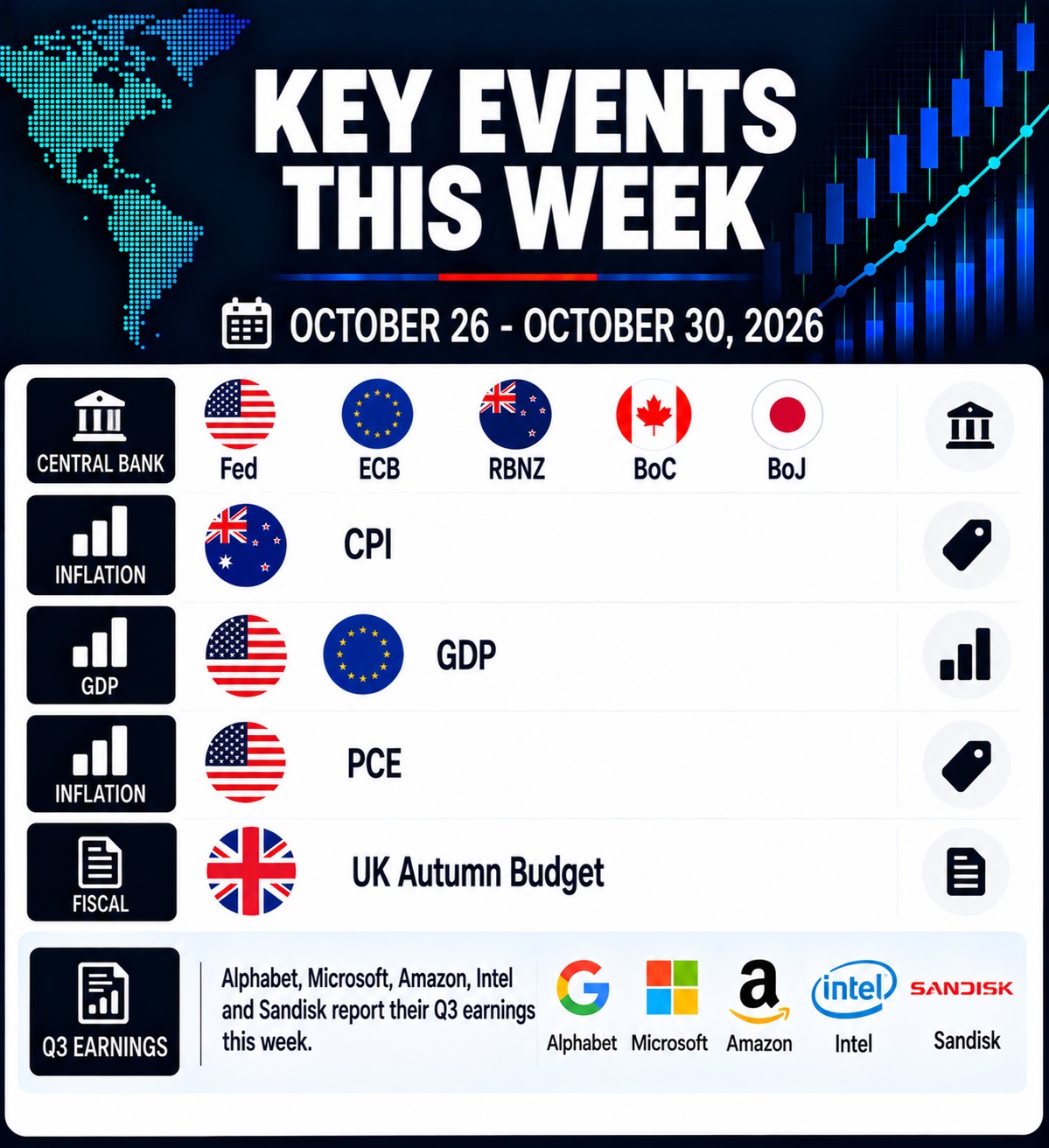
This week we will have first reading of Q3 GDP, Fed’s preferred inflation metric PCE and Fed meeting. No change to rate is expected and with short statement all eyes will be on Warsh’s press conference.
Important news for USD:
Wednesday:
-
Fed Interest Rate Decision
-
GDP
-
PCE
Preliminary October PMI data showed declines across sectors as growth is slowing down. Manufacturing printed 52.4 vs 52.7 as expected and down from 52.9 in September. Services eased to 51.7 from 53 the previous month while markets expected ad 52.5 print and that dragged composite down to 51.9 from 53.1 in September. Eurozone is still expanding as evidenced by rising output and news orders, but they are growing at a slower pace. All three French readings fell into contraction and given the fiscal crisis and surging yields as well as high interest rates the outlook is not pleasant.
This week we will have preliminary Q3 GDP reading as well as ECB meeting. No change is expected. We anticipate that President Lagarde will keep options open for the December meeting but French fiscal crisis could prove to be a big detriment for future rate hikes.
Important news for EUR:
Thursday:
-
ECB Interest Rate Decision
-
GDP
Payrolls change for the month of September saw economy add 13k jobs. August ILO unemployment rate dropped to 4.7% from 4.9% in July while markets were expecting it to tick up to 5%. Weekly earnings eased to 3.7% 3m/y from 3.9% 3m/y the previous month. Despite constant reminders by the ONS that quality of data is not at the highest level this report shows that labor market is tight and that wage growth remains high keeping inflation pressures which should push BoE towards November hike.
CPI report for the month of September saw headline number jump to 3.5% y/y from 3.1% y/y in August surpassing expectations of a 3.4% y/y price increase. Higher energy prices due to US – Iran war are the main reason for rise in inflation. Core CPI also rose coming in at 2.8% y/y, as expected, vs 2.6% y/y the previous month. Services inflation moved up to 3.7% y/y from 3.4% y/y in August but the biggest jump was in airfares which are notoriously volatile. Overall, this is another data print pointing to November hike.
BoE Greene reiterated her pledge for rate hikes in order to avoid potential second-round inflation effects stating that the risk is higher than previously anticipated. She also pointed to stoppage in wage disinflation which in turn adds more inflationary pressures as wage growth is now above levels consistent with targeted 2% inflation. Greene is the most hawkish member of MPC.
Preliminary PMI data for the month of October showed divergence with Eurozone as all three readings improved by more than expected. Manufacturing rose to 52.8 from 51.9 in September, services to 53.1 from 52.1 the previous month and composite was thus lifted to 53.1 from 52 in September. New orders rebounded and helped push numbers higher. There were also reports of firms hiring new workers and thus lifting employment index. Geopolitical uncertainty remains high and inflationary pressures remain “worryingly elevated’.
This week John Healey, the current Chancellor of the Exchequer, will reveal the new Autumn Budget.
Important news for GBP:
Wednesday:
-
Autumn Budget
RBA Assistant Governor Kent stated that there are evidence that neutral rates are raising in Australia as well as abroad. This has led him to question whether monetary policy is restrictive enough. Kent has tempered his hawkish comments by saying that labor market became less tight and that markets were justified to react the way they did after the weak jobs report. No clear direction from his statements just emphasizes importance of Q3 CPI report, due on October 28, on RBA’s decision. Later on during the week RBA Deputy Governor Hauser provided more hawkish comments stating that Q3 trimmed mean is expected to run hotter than predicted. This is a big nod to upside risk to CPI print next week. He added that they have to react to supply shocks in order to keep inflation expectations anchored which is another push towards RBA hike in November.
Q3 GDP from China rose 1.2% q/q and 4.5% y/y thus beating estimates of 1.1% q/q and 4.4% y/y and coming in higher than 0.9% q/q and 4.3% y/y as shown in Q2. Tertiary industry rose by 5.2% y/y while primary industry rose by 3.6% y/y and secondary industry by 3.4% y/y. September activity data was also positive as it showed retail sales rising 1.1% y/y rebounding from 0.4% y/y growth in August and smashing expectations of a 0.5% y/y print. Industrial production grew 5.5% y/y, more than 5.4% y/y as expected and 5.2% y/y the previous month. 1-year and 5-year Loan Prime Rates were kept unchanged at 3% and 3.5% respectively.
This week we will have Q3 inflation report that will determine whether RBA will hike or pause in November.
Important news for AUD:
Wednesday:
-
CPI
Q3 CPI came in at 0.7% q/q and 3.7% y/y, slowing down from 1.5% q/q and 4.1% y/y in Q2. Additionally, both prints were lower than expected (0.8% q/q and 3.8% y/y). Although this was a welcoming reading majority of economists see inflation rising again in Q4 as oil prices continue to increase. Core CPI, sectoral factor model, ticked up to 2.8% y/y from 2.7% y/y in the previous quarter. Given that RBNZ targets it in 1-3% range a tick up should be uncomfortable. September PSI (Performance of Services Index) printed 50.9 thus making it four months in expansion after being in contraction for previous two years. New orders was the strongest subindex while employment was in contraction. Business sentiment, however, remains unchanged with a negative bias among surveyors.
This week we will have RBNZ meeting. We see a 25bp rate hike after above latest CPI report and last week’s hawkish comments by RBNZ chief economist Conway.
Important news for NZD:
Wednesday:
-
RBNZ Interest Rate Decision
Headline CPI for the month of September ticked up to 3.1% y/y from 3% y/y, but it was less than 3.2% y/y markets were expecting. Energy was the main culprit, as everywhere around the world, with prices rising 19% y/y (27.8% y/y for gasoline). Services printed 2.6% y/y while shelter, the largest component of CPI basket, showed a 1.7% y/y price increases. Food from stores component saw prices ease to 1.7% y/y from 2.8% y/y. Unlike headline number, all three core measures came down with common at 2.4% y/y vs 2.6% y/y, median at 1.9% y/y vs 2% y/y and trim at 1.8% y/y vs 1.9% y/y. Despite softer than expected CPI report analysts call for 25bp rate hike next week. Retail sales rebounded 1.2% m/m in August with September advance reading showing a further 0.7% m/m increase.
This week we will have BoC meeting and markets are expecting a 25bp rate hike.
Important news for CAD:
Wednesday:
-
BoC Interest Rate Decision
BoJ Governor Ueda stated importance of anchoring underlying inflation to their 2% target. He said that inflation is coming from both directions, supply-driven due to energy shocks caused by US – Iran war and demand-driven due to strong AI demand. Ueda added that Japan’s moderate recovery and tight labor market are also contributing to inflation. He clarified that there is no change to their stance on tapering its bond purchases.
September inflation report saw all three measures return above 2% for the first time in 2026. Headline and ex fresh food both showed increases of 2.1% y/y up from 1.9% y/y for headline and up from 1.7% y/y for ex fresh food component in August, while ex fresh food, energy, the so-called core-core, printed 2.4% y/y increase in prices, up from 1.9% y/y the previous month. Digging into the details we can see that both goods and services inflation rose with former coming in at 2.8% from 2.6% and latter at 1.5% from 1.2%. Surging energy prices were the main culprit for higher inflation and some analysts now see BoJ moving towards higher terminal rate.
Preliminary October PMI numbers showed manufacturing declining to 53.3 from 54.1 in September while services rose to 52 from 51.3 the previous month leaving composite unchanged at 52.3. The report shows slower pace of growth in new orders and new export orders with employment index declining further. Input costs continued to rise, due to increases in prices of raw material and higher labour costs and companies are continuing to increase prices thus keeping inflation pressures high.
This week we will have BoJ meeting. Reuters has reported that BoJ is expected to keep rates on hold at next week’s meeting but they will increase inflation forecast. Markets are pricing almost 75% chance of a December rate hike.
Important news for JPY:
Friday:
-
BoJ Interest Rate Decision
SNB total sight deposits for the week ending October 16 ticked up to CHF457bn from CHF456.4bn the previous week. Just a minor correction as SNB lets market do its bidding.
You can follow all economic events on the Economic Calendar page on our Website. MT server time is set to GMT+3 and if you need assistance converting MT server time to your local time you can use some of the online time converters such as WorldTimeBuddy.
Please note that this analysis should not be used as investing advice as it is only an overview of the economic events influencing the markets. Please remember that our accounts have Market Execution. Please note how Execution works during high impact news and other times of low liquidity.