
Forex Major Currencies Outlook (Nov 2 – Nov 6, 2026)
Week Ahead Summary
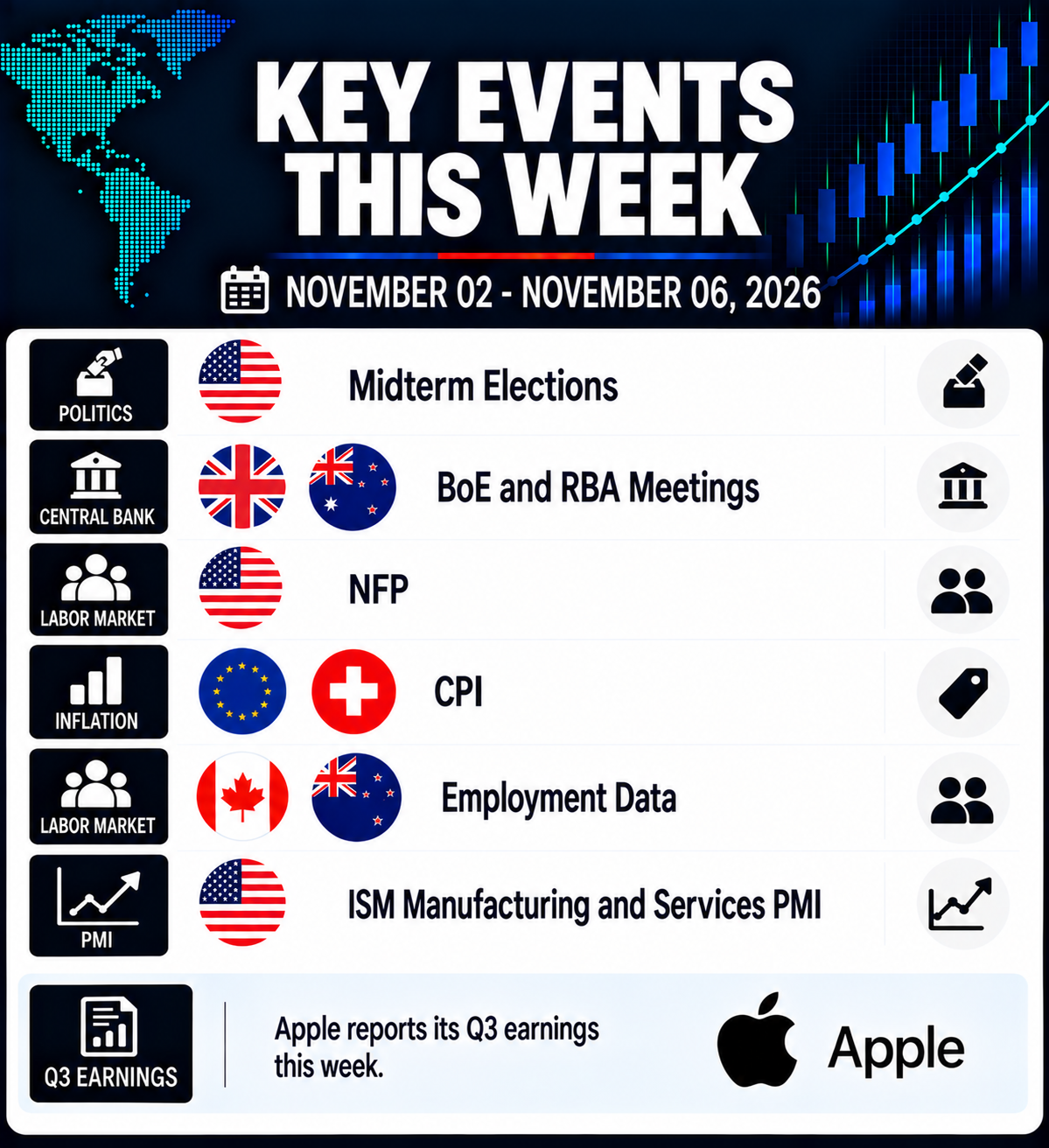
BoE and RBA meetings, both expected to hike rates, NFP, inflation data from the Eurozone and Switzerland, employment data from Canada and New Zealand as well as US Midterm Elections and ISM PMI data will highlight another massive week ahead of us. Apple will report their Q3 earnings.
USD — US Dollar
Third US aircraft carrier group has arrived to the Middle East putting dark clouds over the region as chances of another strike on Iran increase. Consumer confidence for October surged to 91.7 from 81.9 in September which was revised up to 84.2.
Fed decided to leave Federal Funds Rate unchanged at 3.75-4% as was widely expected by the markets. The vote was 10-2 with Lisa Cook and Beth Hammack voting for a 25bp rate hike. The statement shows that economy is growing at a strong pace with strong productivity growth. Inflation remains elevated and the new part shows that “the accumulation of more information will help the Committee determine the policy stance appropriate to ensure a timely return of inflation to the Committee’s 2 percent goal.” Given the 2 dissenters we can say that this decision leans more hawkish.
At the press conference Chairman Warsh reiterated importance of bringing inflation down to 2% target clarifying that this meeting’s pause does not mean easing off on fight against inflation. He acknowledged that financial conditions are tighter but added that he is unwilling and unable to call them tight, yet another hawkish signal. Warsh announced that Fed will change its calendar so that they will still have eight meetings in 2027 but one of them will not be a live meeting and there they will only talk about the bigger macroeconomic situation and in 2028 two of them will not be live meetings but again meetings to talk about bigger macroeconomic picture. There will be two more jobs reports and one more CPI report before the December meeting so committee members will have plenty more information to work with. Warsh stated that growth in Q3 will be above 3% adding that consumption growth is strong all of which should add more to the hawkish leaning Fed.
Q3 GDP came in at 3.4% vs 3.2% annualized as expected and up from 2.2% in Q2. Composition sees that personal consumption expenditure, household spending, contributed with 2.52pp. Gross private domestic investment contributed 3.27pp out of which nonresidential investment, data centers, added 1.78pp. Government consumption added 0.90pp. The big drag on GDP were net exports that detracted 3.32pp from the reading due to surging import of goods needed for AI buildout (-2.77pp). September PCE report saw headline number come in at 3.6% y/y as expected and up from 3.4% y/y in August while core ticked up to 3.1% y/y from 3% y/y the previous month.
The yield on a 10y Treasury started the week at 5.%, rose to 5.04% and finished the week at around 4.94%. The yield on 2y Treasury started the week at 4.69%, rose to 4.77% and finished the week at around 4.56%. Spread between 2y and 10y Treasuries started the week at 31bp and finished the week at 38bp. FedWatchTool sees the probability of a no change at a December meeting at around 26% while probability of a 25bp rate hike is at around 74%. WTI stayed above the $100/bbl during the week while gold dropped and closed below strong support at $4000. Silver fell and closed below $50.
This week we will have ISM PMI data, Midterm Elections, markets are pricing around 70% chance of Democrats taking both the Senate and the House, as well as October NFP on Friday. Headline number is expected around 40k while the unemployment rate is seen staying at 4.2%.
Important news for USD:
Monday:
-
ISM Manufacturing PMI
Tuesday:
-
Midterm Elections
Wednesday:
-
ISM Services PMI
Friday:
-
NFP
-
Unemployment Rate
EUR — Euro
ECB has left key interest rate unchanged at 2.50% as was widely expected. The statement shows concern about rising energy prices and their upward pressure on inflation and downward pressure on growth. There are very little signs of second-round effects but financing conditions have become more restrictive. Governing Council will remain data dependent and make decisions on a meeting-by-meeting basis.
Before the ECB decisions it was announced that President Lagarde will step down from her position on February 7. There are no clear information about who will succeed her but two frontrunners are Pablo Hernández de Cos from Spain and Klaas Knot from the Netherlands. Both are well suited for the position having already led central banks of their respective countries. Sentiment for October data showed that business climate climbed to positive territory for the first time since June of 2023.
At the press conference President Lagarde reiterated that there are no visible second-round effects adding that although there were talks about hiking at this meeting the decision to keep rates unchanged was unanimous. She has warned that inflation will stay well above the target in the coming quarters adding that risks to inflation are to the upside and for growth to the downside. Lagarde stated that countries with high fiscal deficits have to be prepared that rates will stay higher for longer. She put some clear signals that December hike is incoming, stating that “the direction is quite clear”. which was later confirmed by mandatory post-conference leak to the press.
Preliminary Q3 GDP from the Eurozone granted us economy rising at 0.4% q/q and 1.3% y/y beating expectations of a 0.2% q/q and 1.1% y/y growth. Germany showed a 0.2% q/q growth, higher than 0.1% q/q as expected but slower than 0.3% q/q in Q2. The economy grew 1.2% y/y vs 1.1% y/y as expected and up from 1% y/y in the previous quarter. France saw economy contract by 0.1% q/q and y/y. The report shows household consumption growing by 0.4% but investment declined by 0.6%. Additionally, net exports deducted 0.6pp as exports plunged 1.7%. Italy showed no growth in the third quarter rising 0.8% y/y, down from 0.2% q/q and 1% y/y. Spain posted a healthy 0.6% q/q and 2.7% y/y growth.
Preliminary October German CPI eased to 2.8% y/y from 3.3% y/y in September with core CPI also dropping to 2.1% y/y from 2.4% y/y the previous month. French CPI rose to 3.4% y/y from 3.1% y/y in September as energy prices rose 24.1% y/y. Services inflation jumped to 2.7% y/y from 2.4% y/y the previous month raising worries about second-round effects. Inflation rising and GDP declining is a very dangerous mix. Italian CPI showed prices surging 5.4% y/y from 4.2% y/y in September and much higher than 4.6% y/y as expected. Energy prices surged with regulated ones jumping 59.5% y/y! Spanish CPI stayed at very high 4.9% y/y.
This week we will have preliminary October CPI data.
Important news for EUR:
Wednesday:
-
CPI
GBP — British Pound
Autumn Budget showed projected fiscal deficit for 2027 at 3.4% which continues a downward trajectory as 2026 fiscal deficit was at 4.2% and 2025 at 4.4%. Additional forecast see fiscal deficit dropping below 3% in 2028 and below 2% in 2030. Debt issuance will be up just slightly as funding will be done by higher tax receipts. Inflation is pushing more people into higher tax brackets thus lifting revenues from taxation. BoE will not be facing any obstacles from the budget and may proceed with their planned rate hikes.
This week we will have BoE meeting where a 25bp rate hike is widely expected.
Important news for GBP:
Thursday:
-
BoE Interest Rate Decision
AUD — Australian Dollar
Another hot inflation quarter in Australia as headline inflation rose 1.3% q/q and 4.3% y/y in Q3. Trimmed mean measurement, core reading, rose 1% q/q, as expected and 3.7% y/y, higher than 3.6% y/y as expected. Energy prices were the main driver of higher inflation. RBA Governor Bullock reiterated that inflation remains “far too high” adding that it is “difficult to look through supply shocks”. Her hawkish remarks all but cement next week’s hike.
This week we will have RBA meeting. After Q3 inflation data a 25bp rate hike is widely expected.
Important news for AUD:
Tuesday:
-
RBA Interest Rate Decision
NZD — New Zealand Dollar
RBNZ shocked the markets by keeping Official Cash Rate unchanged at 2.75% with a 4-3 vote. Markets were pricing higher than 90% probability of a rate hike. Governor Breman, Hansen, Williams and Gai voted for a hold citing lower than expected inflation in Q3 as well as subdued wages and weak economic recovery as main reasons for their decision. On the other hand, members that voted for a hike mentioned that core inflation is above mid-range of 1-3% for a prolonged time and that prolonged Middle East conflict could lead to inflation becoming entrenched. Members see inflation rising to 4.4% in Q4 as a result of higher energy prices and now weaker Kiwi. They agreed that further tightening will likely be necessary but it will be conditional on incoming data and geopolitical developments.
Governor Breman did some damage control at the press conference stating that further rate hikes are likely and if needed will go into restrictive territory. She also warned that lower currency could add to imported inflation which will happen as they have slammed NZD down with today’s decision. Breman added that recent two rate hikes give them more room to assess situation and make better decision. Her hawkish comments should manage to prevent Kiwi from falling further after NZDUSD has fallen around 1.6% on the hold decision. The following day Breman stated that chances of a December hike are high thus giving Kiwi more support.
This week we will have Q3 employment data.
Important news for NZD:
Tuesday:
-
Employment Change
-
Unemployment Rate
CAD — Canadian Dollar
BoC delivered a 25bp rate hike lifting the overnight rate to 2.75%. Members see higher and more persistent inflation compared to July forecast. New CPI projections see CPI at 2.9% vs 2.5% in July for 2026, 3.1% vs 2% for 2027 (more than a full percentage point higher!) and 2.2% vs 2.1% for 2028. Growth has been seen as picking up inn the current year and is expected to continue increasing. New GDP projections see GDP at 1% vs 0.7% in July for 2026 and 2% for both 2027 and 2028 compared to 1.8% seen for both years in July. The statement finishes with a cautious tone where Governing Council will proceed carefully with future rate hike decisions given the uncertainties.
Governor Macklem’s statement clarified that the discussion was whether to hike by 25bp or keep rates unchanged. “The main argument for holding was that the rise in inflation has so far been concentrated in energy prices and in services that rely heavily on energy inputs, such as airfares.” On the other hand, “The main argument for an increase was that energy prices are higher, they are expected to remain higher, and cost pressures are building.” Macklem emphasized that outlook for inflation has deteriorated adding that growth outlook has improved modestly as recent indicators point to growth of about 2% for Q3. He warned though that growth in Q4 will likely slow as US tariffs take its toll on activity. Even with this rate hike, according to Macklem, rates remain low enough as to not restrain growth. He did not want to commit to any rate path as decisions will be made based on incoming data but warned that inflation is looking less likely to be well contained. BoC statement showed a dovish hike but Macklem leaned more hawkish. Monthly GDP reading for August came in flat, second month of no growth, while preliminary September reading is expected to show economy contracting by 0.1% m/m.
This week we will have employment data.
Important news for CAD:
Friday:
-
Employment Change
-
Unemployment Rate
JPY — Japanese Yen
BoJ has kept policy rate unchanged at 1.25% as widely expected. The vote was 8-1 with one member, Tanaka, voting for a 25bp rate hike. Tanaka’s main argument was that now that underlying inflation reached 2% target it is necessary to raise rates at a faster pace and bring them towards their neutral level. The board unanimously voted on quickening the pace of its ETF sales. Sales will more than double to JPY860bn per year from current JPY330bn per year. The accompanying Outlook Report showed members agreeing that underlying inflation reached 2% target and is expected to stay there. The 2% target was set back in 2013, so it took more than a decade but the target was reached. Members see risks to inflation as skewed to the upside while growth risks are broadly balanced. Three factors are signaled out as contributors to upside risks to prices: energy prices, AI demand and weak JPY. New projections see core CPI unchanged at 2.5% for FY 2026, at 2.6% vs 2.4% previously for FY 2027 and also unchanged at 2% for FY 2028. Growth forecast shows real GDP at 0.7% for FY 2026 and FY 2027 while 0.8% is seen for FY 2028.
BoJ Governor Ueda confirmed at the press conference that all members agreed that underlying inflation reached 2% target. He warned that they must remain vigilant on inflation and not let it get out of hand. Ueda stated that BoJ will continue to raise policy rate in accordance with economic activity, prices and financial developments. He clarified that it is up to government to declare that 2% inflation target has been achieved. Ueda’s comments lean hawkish but they are not guaranteeing December rate hike.
Tokyo area inflation for the month of October saw headline number tick up to 2.8% y/y while markets were expecting it to stay unchanged at 2.7% y/y. Higher energy prices lifted the headline number but they have not spilled into core readings as ex fresh food ticked down to 2.6% y/y as expected and ex fresh food, energy dropped to 2.4% y/y while markets were bracing for a decline to 2.7% y/y from 2.9% y/y in September. Retail sales fell for the second consecutive month but are still up for the year.
CHF — Swiss Franc
SNB total sight deposits for the week ending October 23 came in at CHF455.8bn vs CHF456.4bn the previous week. Deposits are back in the tight range.
This week we will have October inflation data.
Important news for CHF:
Tuesday:
-
CPI
You can follow all economic events on the Economic Calendar page on our Website. MT server time is set to GMT+2 and if you need assistance converting MT server time to your local time you can use some of the online time converters such as WorldTimeBuddy.
Please note that this analysis should not be used as investing advice as it is only an overview of the economic events influencing the markets. Please remember that our accounts have Market Execution. Please note how Execution works during high impact news and other times of low liquidity.