
Forex Major Currencies Outlook (July 20 – July 24, 2026)
Week Ahead Summary
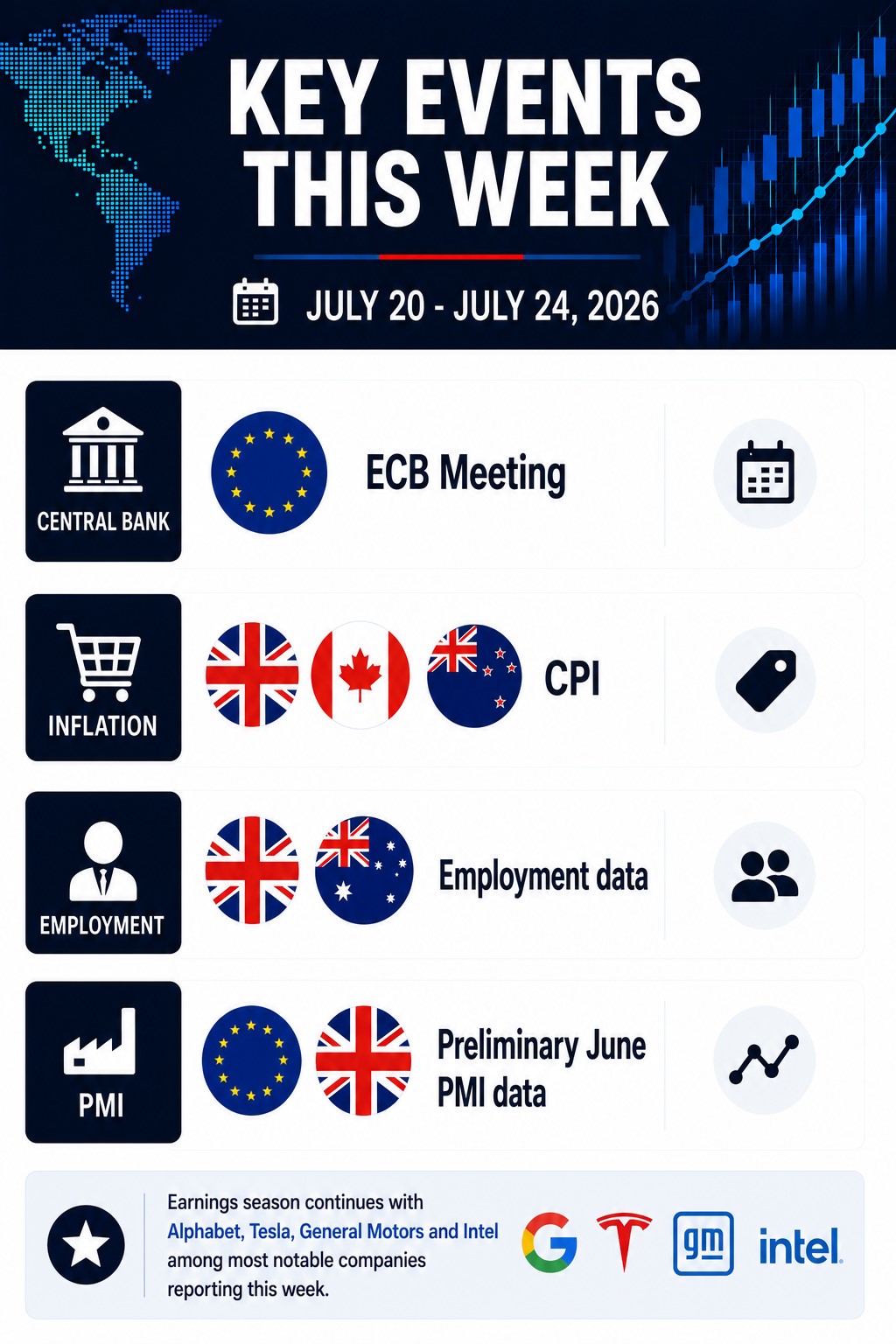
ECB meeting, inflation data from the UK, Canada and New Zealand as well as employment data from the UK and Australia and preliminary June PMI data from the Eurozone and UK will highlight the week ahead of us.
USD — US Dollar
Hostilities between countries are ramping up as US keeps bombing Iran and Iran retaliates by attacking US allies. Iran has stated that they will not follow their commitments from the memorandum of understanding if US continues to breach it. Shipping traffic through the Strait of Hormuz almost stopped over the weekend with only 6 vessels crossing on Sunday. US president Trump stated that they had a deal with Iran and they broke it and that US will get paid to to guard the Strait indicating that US plans to take over control. Iran has been hitting Kuwait and Bahrain with its army threatening more strikes.
June CPI report came in softer than expected with headline number printing 3.5% y/y vs 3.8% y/y as expected and down from 4.2% y/y in May with monthly number declining by 0.4% vs 0.1% as expected. Core came in at 2.6% y/y vs 2.8% y/y as expected, down from 2.9% previous month with no change on a monthly basis while markets were bracing for a 0.2% increase. Energy prices led declines as they slumped 5.7% m/m but are still elevated at 15.7% y/y with fuel oil prices rising 42.9% y/y although it was down 9.2% m/m. Shelter, the biggest component of CPI at 35%, rose just 0.1% m/m, which is the lowest increase in over five years, and 3.3% y/y. Apparel prices declined 0.6% m/m. This report speaks against the need for future rate hikes and USD lost ground as those were prices out. But be mindful that energy prices surged this week so we will see a spike in July CPI print and questions of any second-round effects will prop up.
Fed Governor Waller posted some hawkish comments stating that it will be necessary to see several months of lower core inflation to gain confidence that inflation is moving in the desired direction. Fed Chair Waller testified in front of the Congress and his statement reiterated what he has already said at the June FOMC meeting, that they will remain vigilant on inflation and will have “no tolerance” for persistently high inflation.
June retail sales came in at 0.2% m/m as expected while May reading was revised up to 1% m/m. Control group showed growth of 0.5% m/m after an upwardly revised 0.8% m/m the previous month. Ex autos and ex autos and gas were both weaker than in May but as with other May readings these two categories were revised up thus making this a good print. The report showed strong growth in motor vehicle and parts sales as well as nonstore retailers (online) both growing 1.9% m/m. The biggest decline was in gasoline stations and it coincides with a drop in energy prices. We can see gasoline stations growing back in July on the back of higher energy prices. Food and drinking places, a good proxy for discretionary spending, rose just 0.1% m/m.
The yield on a 10y Treasury started the week at 4.56%, rose to 4.64% and finished the week at around 4.49%. The yield on 2y Treasury started the week at 4.22%, rose to 4.31% and finished the week at around 4.19%. Spread between 2y and 10y Treasuries started the week at 35bp and finished the week at 35bp. FedWatchTool sees the probability of a no change at a July meeting at around 66% while probability of a 25bp rate hike is at around 34%. WTI prices started the week at around $74 and then rose above the $80 level on renewed attacks in the Middle East. above it by the end of the week. Gold briefly fell below $4000 as higher oil prices increased chances of further rate hikes which led to higher real yields so they in combination pushed the price down and finished around $4000.
EUR — Euro
Final Eurozone inflation for the month of June was confirmed coming down with headline CPI printing 2.8% y/y and core CPI printing 2.4% y/y. Services inflation declined to 3.2% y/y from 3.5% y/y in May while food inflation dropped to 1.5% y/y from 1.8% y/y the previous month. Energy prices coming down were the main reason for drop in inflation and headline CPI declined 0.1% m/m. Spanish inflation reading was unchanged for headline at 3.2% y/y while core CPI ticked down to 2.9% y/y from 3% y/y as preliminary reported. Italy inflation mirrored Spanish as both headline and core CPI came in at 3% y/y with former being unchanged and latter ticking down from 3.1% y/y the previous month.
This week we will have ECB meeting and preliminary July PMI data. No change is expected at the ECB meeting but we expect that they will leave possibility of a September rate hike open due to renewed US – Iran hostilities and increased energy prices as a result of that.
Important news for EUR:
Thursday:
-
ECB Interest Rate Decision
Friday:
-
Manufacturing PMI (Eurozone, Germany, France)
-
Services PMI (Eurozone, Germany, France)
-
Composite PMI (Eurozone, Germany, France)
GBP — British Pound
Andy Burnham, incoming Prime Minister, is considering an expansive autumn budget as reported by the Financial Times. The newly formed plan should bring in together both spending and taxing intentions in a single statement. Shabana Mahmood is now seen as the front runner for new Chancellor of Exchequer position. She is seen as a more to the right in the Labour party and more of a fiscal conservative. Markets have celebrated her nomination with Gilts and GBP both strengthening. UK economy grew by 0.1% m/m in May after declining 0.1% m/m in April. Growth was led by the services sector with a 0.3% m/m increase while industrial output and construction output fell 0.5% m/m and 0.8% m/m respectively.
This week we will have employment, inflation and preliminary June PMI data.
Important news for GBP:
Tuesday:
- Payrolls Change
- Unemployment Rate
Wednesday:
-
CPI
Friday:
-
Manufacturing PMI
-
Services PMI
-
Composite PMI
AUD — Australian Dollar
Chinese trade balance data for the month of June showed trade surplus surge to $125.6bn from $105.4bn in May beating expectations for a $121bn print. Exports rose 27% y/y while imports jumped 36% y/y, both increases not seen since 2021. Exports of semiconductors surged 121.9% y/y in June and 96.1% y/y for H1 as AI related demand is booming. There was also a boost to exports from US demand as retailers moved their purchases of goods for Black Friday and Christmas four to six weeks earlier than usual in anticipation of higher tariffs on Chinese goods later this year. On the imports side imports of Automatic Data Processing Machines and parts skyrocketed 156.7% y/y in June. Crude oil imports were down 7.5% y/y.
China Q2 GDP data came in at 0.9% q/q, as expected and 4.3% y/y, lower than 4.5% y/y as expected and is the slowest growth rate since pandemic hit Q4 of 2022. Both readings were down from Q1 prints of 1.3% q/q and 5% y/y as supply shocks caused by US – Iran war hurt the economy. The report shows that tertiary sector led the growth as it grew 5.2% y/y. Industrial production continued to improve in June rising 5.3% y/y after a 4.5% y/y growth in May. High-tech manufacturing was the biggest contributor as external demand for AI related products continued to surge. Retail sales managed to rebound and print 1% y/y growth after a 0.6% y/y decline previous month. Communication services, cosmetics as well as alcohol and tobacco had double digits y/y increases in June. Fixed Asset Investment, on the other hand, resumed its downward trend as it fell 5.7% y/y with property investment dropping 18% y/y in H1 of 2026.
This week we will have employment data.
Important news for AUD:
Thursday:
-
Employment Change
-
Unemployment Rate
NZD — New Zealand Dollar
RBNZ Chief Economist Conway stated that higher oil prices could lead to increase in inflation expectations. He then firmly added that they will get inflation back to 2% over the medium-term as he sees medium-term inflation expectations staying well anchored. He clarified that future rate hikes are intended to make monetary conditions less stimulative and that idea is to hike rates towards neutral rate. These are hawkish comments and will support NZD strengthening. Electronic retail sales for June, comprising around 70% of retail sales, showed a decline of 1.4% m/m and increase of 1.3% y/y.
This week we will have Q2 inflation data.
Important news for NZD:
Tuesday:
- CPI
CAD — Canadian Dollar
BoC has left rates unchanged at 2.25% as was widely expected. The statement showed upbeat tone stating that economy is showing signs of improvement, with Q2 growth estimated at around 2.5%, and that inflation is expected to ease gradually. Business investment is projected to pick up moderately. Concerns are with labour market as they judge it to be soft and they are highlighting high uncertainty which will most likely leave them on the sidelines in terms of monetary policy changes for a while. New forecasts see GDP at 0.7% for 2026, down from 1.2% in April while 2027 and 2028 growth has been revised up and now sits at 1.8% for both years. Inflation is seen higher in 2026 at 2.5% and then returns to 2% in 2027 before ticking higher to 2.1% in 2028.
This week we will have inflation data.
Important news for CAD:
Monday:
-
CPI
JPY — Japanese Yen
Prime Minister Takaichi stated that there is no connection between government plan that will lead to for looser fiscal policy and more spending and surging bond yields. She added that yields are rising due to various factors including US interest rates and economic indicators.
CHF — Swiss Franc
SNB total sight deposits for the week ending July 10 came in at CHF471.3bn vs CHF479.2bn the previous week. This is the lowest level in a month and may represent just a pull back before trend continues and deposits cross the 480bn level. Minutes from the June SNB meeting showed that members are satisfied with current monetary policy and although they have raised inflation expectations in the near-term they see medium-term inflation expectations as well anchored.
You can follow all economic events on the Economic Calendar page on our Website. MT server time is set to GMT+3 and if you need assistance converting MT server time to your local time you can use some of the online time converters such as WorldTimeBuddy.
Please note that this analysis should not be used as investing advice as it is only an overview of the economic events influencing the markets. Please remember that our accounts have Market Execution. Please note how Execution works during high impact news and other times of low liquidity.