
Forex Major Currencies Outlook (Aug 10 – Aug 14, 2026)
Week Ahead Summary
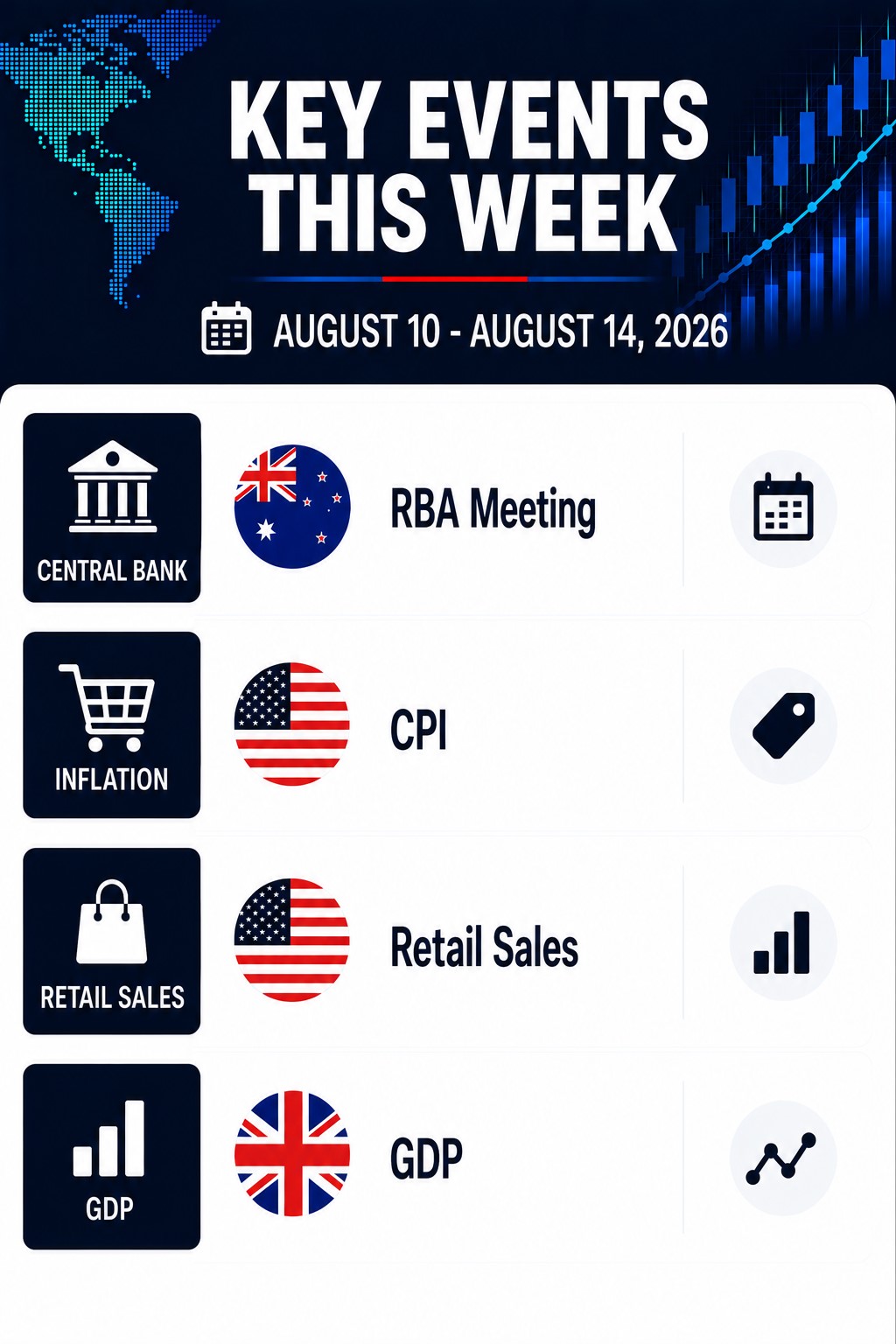
RBA meeting, Inflation and retail sales data from the US with preliminary Q2 GDP from the UK will highlight the week ahead of us.
USD — US Dollar
July ISM manufacturing PMI surged to 55.6 from 53.3 in June beating expectations for a 54 print. Production surged to almost 60 level. Improvements were seen in backlog of orders, new orders and new export orders with latter returning to expansion. Employment index also returned to expansion with a 52.8 print. Prices paid component continued to decline, coming in line with expectations, but still staying very elevated at 71.1.
Colby Smith from New York Times broke a story that Fed Chairman Warsh is considering reducing the number of FOMC meetings in a year. They reported that if the change is to occur it will be announced before September. Bloomberg reported that the aim is for six rate-setting meetings plus additional two meetings that will be focused on the broader economy.
Iran and Oman are in discussion to have a joint supervision of Straight of Hormuz (SoH). The agreement should have Iran controlling inbound transport and Oman controlling outbound traffic and would most likely include some soft of fee for passing ships. US is vehemently opposed to any fees for what was once a free shipping waterway.
ISM services PMI for the month of July came in at 54.1, thus ticking up from 54 in June, but coming in lower than 54.5 that market projected. The report shows surge in business activity which printed 59.1 and was most likely boosted by World Cup. New orders also rose printing 57.2 while employment index plunged into contraction with a 47.4 print. Prices paid rose above 70 showing unrelenting inflation pressures.
July employment report saw headline NFP number show 23k job losses instead of 80k job gains as markets were expecting. June print was revised down to 20k from 57k as previously reported thus making two-month revision showing that economy added 103k jobs less than previously reported. The unemployment rate ticked down to 4.1% as a result of participation rate declining to 61.4%. Wages continued to grow but at a lower rate of 0.1% m/m and 3.2% y/y vs 0.3% m/m and 3.5% y/y as expected. One positive is that all of the jobs created were in the manufacturing sector, private payrolls (30k) while government jobs showed 53k job losses. Chances of a September rate hike were coming down after the report was published and USD was losing ground.
The yield on a 10y Treasury started the week at 4.74% which was the high of the week and finished the week at around 4.65%. The yield on 2y Treasury started the week at 4.30%, rose to 4.31% and finished the week at around 4.19%. Spread between 2y and 10y Treasuries started the week at 46bp and finished the week at 46bp. FedWatchTool sees the probability of a no change at a September meeting at around 56% while probability of a 25bp rate hike is at around 44%. WTI prices started the week with a gap to $80 as there were no attacks over the weekend and then fell to $75 on the positive talks about SoH reopening and finish the week at around $78. Gold surged above $4100 on positive talks regarding SoH, then surged and finished the week at around $4350. AI trade has returned in full force and caused S&P and Russell 2000 to reach new ATHs with latter crossing the 3000 level.
This week we will have inflation and retail sales data for the month of July. Inflation is expected to show increase in monthly figures but continue with downward trend on a y/y basis while retail sales are expected to continue growing.
Important news for USD:
Wednesday:
-
CPI
Friday:
-
GDP
EUR — Euro
Eurozone final manufacturing PMI in July ticked down to 51.9 from 52 as preliminary reported but still shows healthy improvement from 51.4 in June. German reading was unchanged at 52.2 while French reading returned to contraction with 49.8 and Italian print missed expectations. The report shows that new orders continue to grow pushing manufacturing output to new highs but weakness is showing in new work inflows and employment. Final services PMI was revised up to 51.7 from 51.6 as preliminary reported on the back of positive German revision as well as beats from Italy and Spain with latter printing astonishing 58.3 from 54.2 in June. The report showed strong growth in output and new orders. Both input costs and output prices declined showing easing inflation pressures, but this was before renewed surge in energy prices. Composite was also revised up and now it shows 52 compared to 51.9 as preliminary reported.
GBP — British Pound
July final manufacturing PMI was revised down to 51.9 from 52.8 as preliminary reported and thus making second consecutive month of declines as June showed 52.5 print. The report paints a much more favourable picture as it shows that new orders, new export orders and output continue to grow and even pick up speed rising at faster rates. Additionally, inflation pressures are easing as indicated by input costs rising at a slower rate. Unfortunately this was not able to help labour market as employment index was unchanged. Final services PMI was revised up to 52.1 from 51.8 as preliminary reported on the back of increase in business activity and decline in input costs. However, employment continued to decline. Composite was also revised up and printed 52.2 vs 52.1 as preliminary reported.
This week we will have preliminary Q2 GDP reading
Important news for GBP:
Thursday:
-
GDP
AUD — Australian Dollar
RatingDog manufacturing PMI, a private survey of small and medium-sized companies in China, declined to 50.9 in July from 51.7 in June. The reading stays in expansion but it has been declining for the third straight month. The report paints a much brighter picture as new orders continued to surge and new export orders returned to expansion. Employment rose as well and on the inflation front output costs were broadly unchanged with input costs easing. RatingDog services PMI plunged to 50.4 from 54.1 the previous month, barely staying in expansion. New export orders printed 52 indicating that foreign demand remains strong but raising questions then about domestic demand. Positives are that employment continued to increase as well as backlog of orders which should give us higher new orders in the coming months. Composite dropped to 50.8 from 53.6 in June for the lowest print since June of 2025.
July trade balance data from China showed surplus of $112bn, more than $107bn as expected, but still a decline from massive $125bn surplus in June. Exports rose 23% y/y while imports printed a 27.5% y/y growth. Demand for AI related goods was the main driver of exports. Stronger domestic demand for semiconductors and similar high-tech components was the main driver of surge in exports indicating strong domestic demand for AI and advanced manufacturing as well. Coal and natural gas imports rose as well while oil imports continued to decline but at a slower pace.
This week we will have RBA meeting. No change to rate is expected as inflation did come down in Q2, well below RBA forecast.
Important news for AUD:
Tuesday:
-
RBA Interest Rate Decision
NZD — New Zealand Dollar
Q2 employment report was dominated by the negative data print showing the unemployment rate surging to 5.6% from upwardly revised 5.4% in Q1. This makes it the highest unemployment rate since 2015. Other details or report are very positive as employment change was up 0.5% q/q vs 0.1% q/q as expected and participation rate surged to 70.7% from 70.4% the previous quarter. Average wage growth was just 2% while private wages rose by 2.1%. Markets are still pricing in rate hike at the September meeting but higher unemployment rate will bring some discussion within RBNZ.
CAD — Canadian Dollar
July employment report was a stellar one. The economy added 75.1k jobs thus smashing expectations of 15k jobs and adding around 180k jobs in the past three months. The unemployment rate ticked down to 6.5% while at the same time participation rate ticked up to 65.1%. Composition of jobs added shows 38.6k full-time jobs added and 36.6k part-time jobs added. As a result growth of average wages has declined to 3% y/y from 3.7% y/y in June.
JPY — Japanese Yen
Final manufacturing PMI for the month of July showed a 54.5, a small decline from 54.8 in June. The report shows fastest growth in manufacturing output in over twelve years due to the surge in new orders. New export orders jumped as well as demand for semiconductors and everything AI related is going through the roof. Higher demand for products led to need for more staff so employment improved as well. Input costs, pushed higher by oil prices due to the US – Iran war, stayed very elevated. Final services dropped to 51.2 from 52.2 the previous month on the back of slower growth in new businesses and employment while input costs rose sharply due to the disruptions caused by US – Iran war. Composite was, however, little changed and printed 52.7.
Wages continued to grow in the month of June and printed a healthy 3.4% y/y as expected. Real wages rose 1.6% y/y thus making real wages rise every month this year, six consecutive increases. On the other hand, household spending fell 3.3% y/y and 6.4% m/m making it seventh consecutive months of declines. BoJ has stated multiple times that they wish to see demand-pull inflation and with real wages on a steady growth path they should be satisfied but household spending complicates the picture on the health of Japanese consumer as well as strength of domestic demand and raises questions about September rate hike.
CHF — Swiss Franc
SNB total sight deposits for the week ending July 31 came in at CHF465.2bn vs CHF469.3bn. Deposits are continuing their downward trend that started on July 3. July inflation report saw numbers come in line with expectations with headline CPI printing 0.4% y/y, a tick down from 0.5% y/y in June, while core CPI stayed steady at 0.3% y/y. While whole world is fighting inflation battle strong Swissy is making SNB fight with potential deflation.
You can follow all economic events on the Economic Calendar page on our Website. MT server time is set to GMT+3 and if you need assistance converting MT server time to your local time you can use some of the online time converters such as WorldTimeBuddy.
Please note that this analysis should not be used as investing advice as it is only an overview of the economic events influencing the markets. Please remember that our accounts have Market Execution. Please note how Execution works during high impact news and other times of low liquidity.