
Forex Major Currencies Outlook (Oct 5 – Oct 9, 2026)
Week Ahead Summary
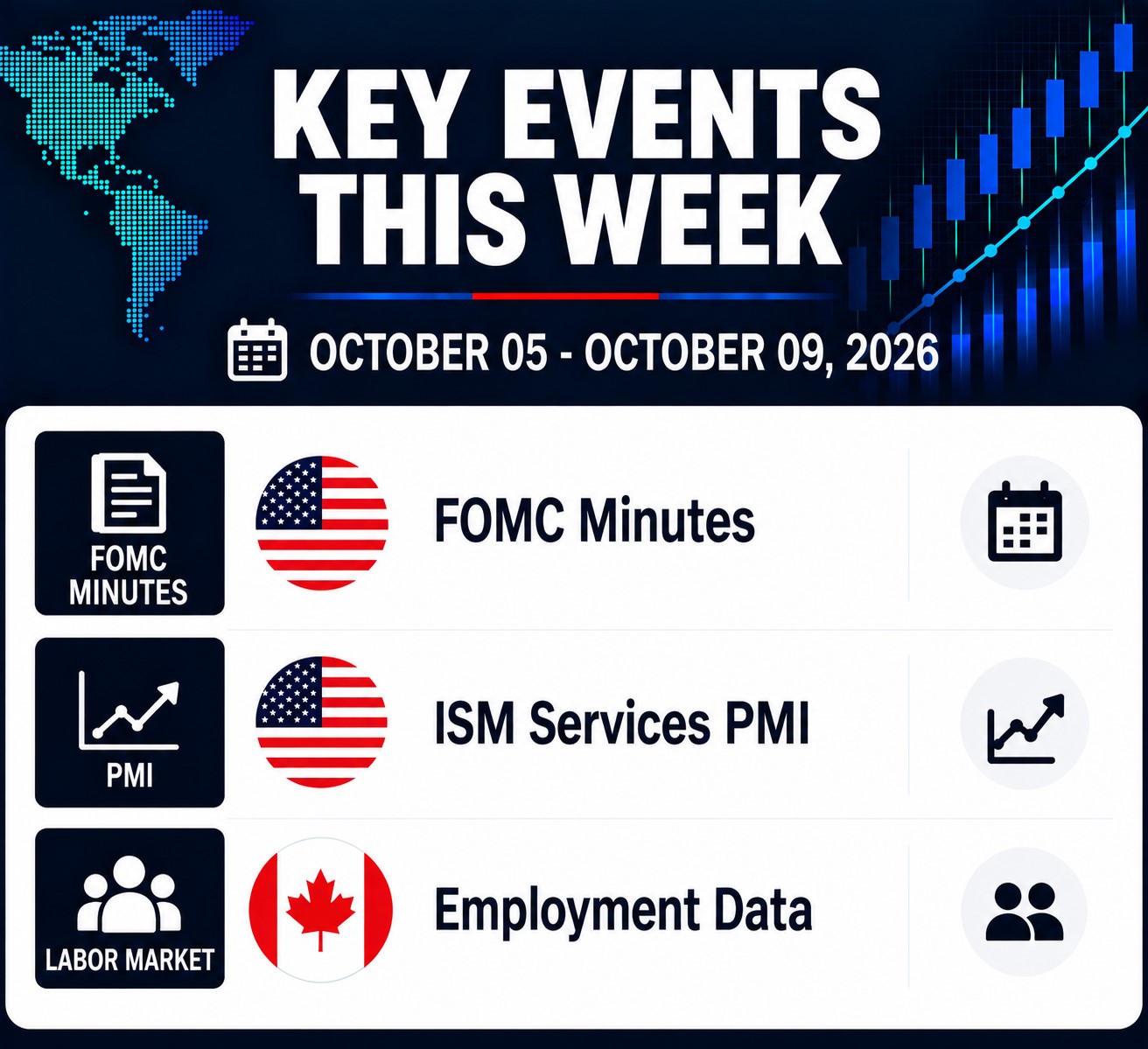
Minutes from the latest FOMC meeting, ISM services PMI and Canadian employment will highlight the quiet first full week of Q4 ahead of us.
USD — US Dollar
Talks of de-escalation in the US – Iran war have gone down the drain after President Trump stated in his speech in UN General Assembly that the deal with Iran will come after midterm elections in November. Iran then announced their proposal to reopen Straight of Hormuz if its conditions are met but the proposal was shut down by Trump. US administration is pressuring EU, Germany and France particularly, to release strategic reserves of diesel and help ease the shortages. US is asking EU to release as much as 120 million barrels of diesel in the coming six months.
August PCE data saw headline number drop to 3.4% y/y from 3.7% y/y in July while core print declined to 3% y/y from 3.3% y/y the previous month. Expectations were for both numbers to stay unchanged from July. Monthly prints also came in lower than expected with headline printing 0.3% and core 0.2%. Fed members will be satisfied with a lower than expected print and USD has weakened as a result of the print. Final reading of Q2 GDP saw it revised up to 2.2% annualized from 1.5% as reported in the advanced and second print. Consumer spending was revised up to 3.8% from 3.4% as previously reported and contributed 2.51pp to the reading.
ISM manufacturing PMI for the month of September eased to 54.5 from 54.6 in August while markets were expecting a 55 reading. The report shows further growth in new orders and employment which are both moving deeper into expansion category. One very worrying signal is prices paid index which surged to 77.9, smashing expectations of a 72.3 and indicating that inflation pressures in manufacturing sector are intensifying.
Employment report for the month of September showed economy adding 29k jobs vs 90k as expected. August print was revised down to 133k from 162k as preliminary reported. The unemployment rate ticked higher to 4.2% as a result of participation rate increasing to 61.8%. Wages were muted coming in at 0.1% m/m and 3% y/y vs 0.3% m/m and 3.1% y/y the previous month indicating that price pressures are not going to come from the demand side. The economy added 46k payrolls in the private sector and lost 19k government jobs. Healthcare was again leading sector adding 17k jobs followed by construction with 11k and manufacturing with 9k. Losses were concentrated in the services sector, information, professional business services as well as financials leading the way. This report will squash chances of another rate hike in October.
The yield on a 10y Treasury started the week at 5.17%, rose to new high for the year of 5.35% and finished the week at around 5.28%. The yield on 2y Treasury started the week at 4.87%, also rose to new high for the year of 4.97% and finished the week at around 4.83%. Spread between 2y and 10y Treasuries started the week at 31bp and finished the week at 45bp. After weak NFP report FedWatchTool sees the probability of a no change at a September meeting at around 82% while probability of a 25bp rate hike is at around 18%.
This week we will have September ISM services PMI as well as minutes from the latest FOMC meeting.
Important news for USD:
Monday:
-
ISM Services PMI
Wednesday:
-
FOMC Minutes
EUR — Euro
ECB President Lagarde stated that growth is expected to remain broad-based and that labor market remains robust. She warned that outlook remains highly uncertain and that members see higher inflation ahead. As a result of that ECB members are opting for a “measured approach” to keep inflation in check.
Preliminary September CPI data for the Eurozone showed headline number rise to 3.8% y/y, more than 3.6% y/y as expected and up from 3.2% y/y in August. Energy prices led the way with surge of 18.8%. Core reading ticked up to 2.5% y/y as expected as services inflation rose to 3.2% y/y from 3% y/y the previous month. German print had headline rise to 3.3% y/y from 2.9% y/y in August while core printed 2.4% y/y. France showed headline CPI jump to 3% y/y, higher than 2.8% y/y as expected. The increase was led by energy prices but the report shows much broader price pressures as both services and food inflation saw increases. Spain saw headline number surge to 4.9% y/y from 4.3% y/y in August while 4.6% y/y print was expected mainly due to rise in energy prices. Core inflation printed 3.1% y/y, rising from 2.9% y/y the previous month indicating that inflation pressures are more broad-based than just contained to energy prices. ECB will be pressured by higher inflation into further hikes.
GBP — British Pound
BoE Deputy Governor Ramsden, one of the most dovish MPC members, warned that if energy prices stay elevated they could justify a rate hike. His comments, considering his leanings, gave boost to GBP at the start of the week and vindicated market’s pricing for BoE hike in November. BoE member Taylor dampened expectations for future rate hikes stating that there is no need for them as second-round effects are not noticeable, but then added that if they are to appear he would be up for rate hikes. UK Prime Minster Andy Burnham stated that he will push to formally start a debate if UK should start moving closer to the EU potential culminating in UK joining the EU after the next elections.
Final Q2 GDP was revised up to show growth of 0.5% q/q and 1.4% y/y. Household consumption was unchanged at 0.3% while business investment was revised up to 1.8% from 1.7% in the first quarter. Government consumption was revised down and showed a decline of 0.5%. The boost to GDP came in from net exports dominated by higher exports (2.8% vs 0.5% as preliminary reported). Services rose by 0.6% and construction by 0.8% while production declined 0.1%.
AUD — Australian Dollar
RBA has raised rates by 25bp, as widely expected, thus lifting the cash rate to 4.60%. The decision to hike was unanimous. The statement shows that uncertainty regarding domestic economic activity outlook remains high. Inflation remains too high and some upside risks that were mentioned at the previous meeting are materializing. The board stands ready to bring inflation down to the target which could include further rate hikes if needed.
RBA Governor Bullock reiterated at the press conference that the board stands ready to hike rates further if needed. She clarified that discussion at this meeting was whether o raise rates or hold them at current level. Inflation is driven by domestic capacity pressures and inflation pressures will last longer than expected. Bullock added that board members think financial conditions are restrictive and that if inflation comes down there will be no need for future rate hikes. These last comments toned down hawkish statement and put dovish tones in governor’s speech causing AUD to weaken as markets are pricing out some of the hikes and pricing in potential hold till the end of the year.
August CPI surged to 4% y/y as expected from 3.5% y/y in July on the back of higher fuel prices. Trimmed mean held, RBAs preferred measure, held steady at 3.6% y/y. Reminder that the targeted range is 2-3% so it still sits well outside the range. Governor Bullock stated at the press conference that RBA will not put too much emphasis on August CPI print.
September PMI data from China showed improvements in both official and private data. Official manufacturing PMI, as well as non-manufacturing PMI, returned to expansion with 50.1 and 50.2 prints respectively thus lifting composite to 50.7. Within manufacturing sector the production subindex rose to 51.7 while new orders and new export orders both ticked down to 50.5 and 50 respectively. Within services sector new orders and new export orders both improved though they still remain in contraction while business expectations continued to move further into expansion and printed 55.5 The price subindex in both sectors strengthened which should indicate higher inflation prints coming. RatingDog, private PMI, showed manufacturing at 52.1, up from 51.5 in August, services at 51.6 vs 51.4 the previous month while composite rose to 52.4 from 52.1 in August.
NZD — New Zealand Dollar
September ANZ business outlook survey showed business confidence slide to 51.9 from 53.7 in August. The biggest increase was seen in residential construction while all other sectors followed by investment intentions. The category of activity compared to one year ago showed the biggest decline while declines were also seen in employment and pricing intentions as well as in profit expectations. The survey showed cost and wage expectations rising, the latter for the period of twelve monthsr, while inflation expectations for the next year remained steady at 3.25%.
CAD — Canadian Dollar
July GDP came in flat as expected. Positives were seen in construction and utilities while retail sales, led by gasoline stations and manufacturing deducted from the reading. June reading was revised up and preliminary August reading is seen showing growth of 0.2% m/m which gives a positive shine on this reading.
This week we will have September employment report.
Important news for CAD:
Friday:
-
Employment Change
-
Unemployment Rate
JPY — Japanese Yen
Final manufacturing PMI for September declined to 54.1 from 54.9 in August. The report shows continued rise in output but the pace slowing while new orders eased from the highs in August. New export orders and employment rose at a healthy pace. Input prices declined but selling price rose at a faster pace indicating still persistent inflationary pressures. The reading is still well in expansion and optimism is prevailing as businesses expect output to continue to rise.
September CPI data for the Tokyo Area saw prices surge as headline number came in at 2.7% y/y vs 2.5% y/y as expected and up from 1.9% y/y in August. Ex frrsh food category also printed 2.7% y/y while ex fresh food, energy jumped full percentage point and now shows price growth of 3% y/y compared to 2% y/y the previous month. Water bill subsidies are coming out of the indexes and that was the big part of higher inflation prints but the report shows that price increases were broad-based including food, transport and hotel charges. Additionally, services inflation surged to 2.3% y/y from 1.4% y/y in August showing that companies are increasing the pace of cost transferring to consumers. This data point suggests that BoJ should continue with rate hikes.
CHF — Swiss Franc
SNB total sight deposits for the week ending September 25 came in at CHF456.8bn vs CHF454bn the previous week. This makes it a second consecutive week of rising deposits as they seem to be bouncing from the lows of the year. September CPI saw headline number rise to 1% y/y, as expected, from 0.8% y/y in August due to the higher energy prices. Core CPI ticked higher to 0.5% y/y from 0.4% y/y the previous month. Given that SNB targets it in range from 0 to 2% there is no need for them to take any action and they may welcome this move up.
You can follow all economic events on the Economic Calendar page on our Website. MT server time is set to GMT+3 and if you need assistance converting MT server time to your local time you can use some of the online time converters such as WorldTimeBuddy.
Please note that this analysis should not be used as investing advice as it is only an overview of the economic events influencing the markets. Please remember that our accounts have Market Execution. Please note how Execution works during high impact news and other times of low liquidity.