
Forex Major Currencies Outlook (Sep 7 – Sep 11, 2026)
Week Ahead Summary
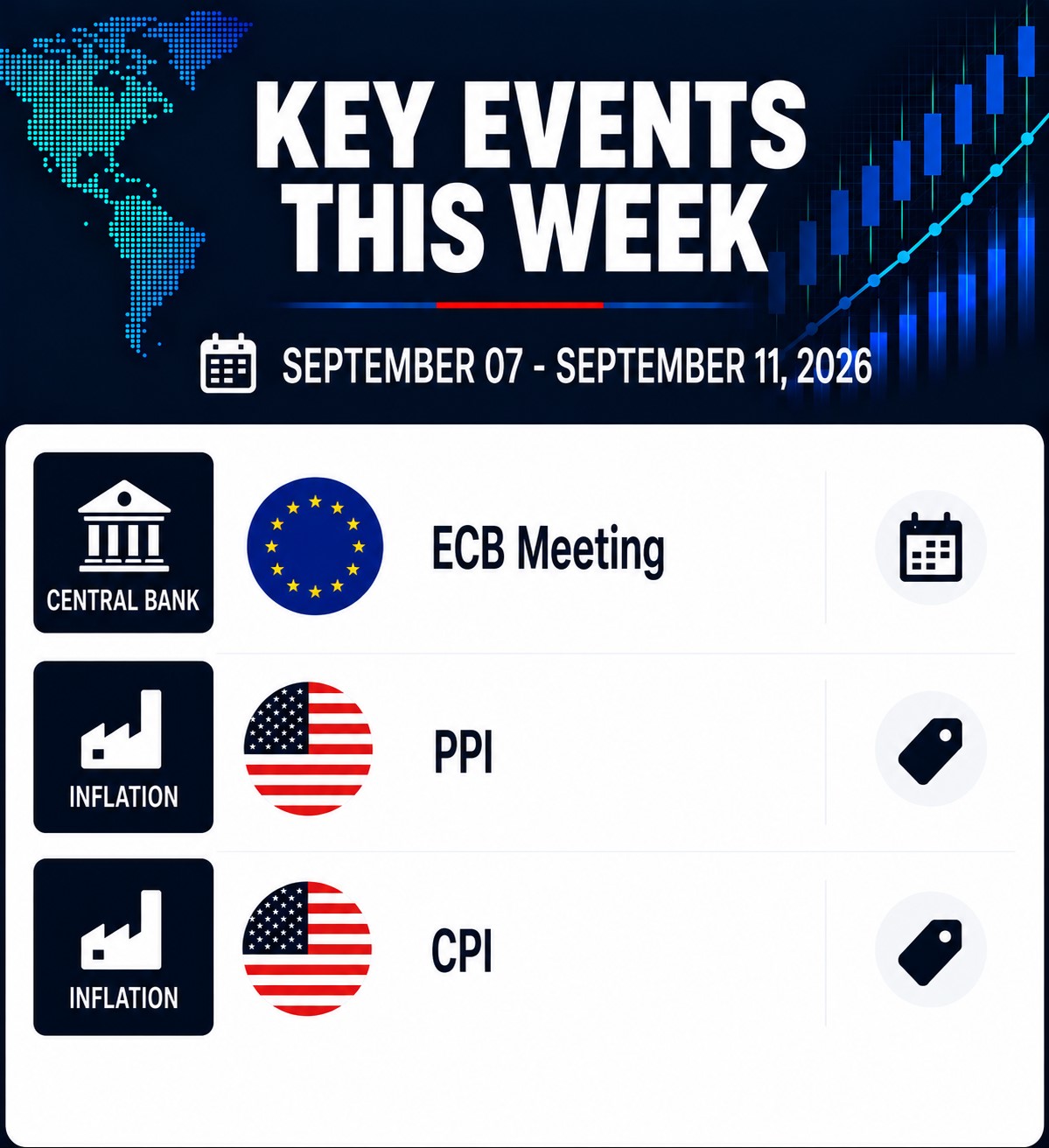
ECB meeting as well as August PPI and CPI data from the US will highlight the week ahead of us. Please note that markets will be closed in the US on Monday for Labor day so liquidity will be lower.
USD — US Dollar
US has struck Larak Island and in retaliation Iran fired missiles from four different launching sites towards the Straight of Hormuz. Tensions are brewing and moving towards further escalation and WTI gaped on the market open to above $86/bbl. Treasury Secretary Bessent spoke at the G20 meeting and stated that Iran is lashing out militarily since they are losing economically as sanctions imposed on them are creating serious pressure. On the domestic economy he stated that the plan is to grow their way out of the debt. Joh Ternus has taken over as Apple CEO from September 1. Presidents Trump and Xi will meet in Washington on September 24. Fed Governor Waller stated that if CPI data shows that process of disinflation has stalled he is open to vote for rate hikes in September. On the other hand, if it shows that inflation eases he is open to leave rates unchanged. Waller refrained from giving exact numbers but if the three-month inflation number gets to 2.8% he would be satisfied with that.
ISM manufacturing PMI for the month of August eased to 54.6 from 55.6 in July missing the expectations of 55.2. The report shows drops in employment, production, backlog of orders and new orders, although all remain in expansion with production running near the 60 level. Prices paid was unchanged and remains very elevated at over 70 warning that inflation pressures are not budging. ISM services PMI rose to 55.4 in August from 54.1 in July stronger than 54.2 that markets were expecting. Business activity and new orders continued to improve, both rising above the 60 level while employment improved a bit but is still in contraction territory. Prices paid rose further pushing further from the 70 level and putting inflation pressures front and center.
August NFP smashed expectations with headline number showing economy added 162k jobs vs 56k as was expected. On top of almost triple more jobs than expected there were positive revisions to the previous two months of 55k jobs. The unemployment rate stayed at 4.1% while participation rate moved up to 61.6% from 61.4% in July. Wages moved higher as they rose 0.3% m/m and 3.1% y/y. Majority of added jobs were in private sector, private payrolls grew by 127k while government provided 35k jobs. Leisure and hospitality added 62k jobs followed by private education & healthcare with 29k while construction added 22k and manufacturing added 16k. This is a very strong report and will only amplify importance of next week’s CPI for the future of monetary policy.
The yield on a 10y Treasury started the week at 4.72%, rose to 4.82% and finished the week at around 4.78%. The yield on 2y Treasury started the week at 4.35%, rose to 4.42% and finished the week at around 4.39%. The yield on a 30y Treasury reached new 30-year high of 5.32%. Spread between 2y and 10y Treasuries started the week at 37bp and finished the week at 42bp. FedWatchTool sees the probability of a no change at a September meeting at around 40% while probability of a 25bp rate hike is at around 60%. WTI prices surged during the week as US – Iran war escalated as US conducted attacks on Iranian tankers and stayed above $90 for the remainder of the week.
This week we will have PPI and CPI data. Comments from Governor Warsh put more importance on CPI print but given that PPI comes out before CPI its importance cannot be overstated. Using data from PPI and CPI we can estimate with great accuracy what Fed’s preferred inflation measure PCE will be.
Important news for USD:
Thursday:
- PPI
Friday:
-
CPI
EUR — Euro
Preliminary August inflation report saw headline CPI rise to 3.3% y/y from 2.9% y/y in July on the back of surge in energy prices which rose 14.3% y/y and 2.9% m/m. Core CPI eased to 2.4% y/y from 2.5% y/y the previous month as services inflation came down to 3%. So far there are no signs of second-round effects from higher energy prices but the longer they stay elevated the greater the chance that those second-round effects appear. German CPI saw prices rise 2.9% y/y vs 2.8% y/y in July, but slower than 3% y/y increase as expected. The increase was led by energy prices which rose 10.3% y/y. Additionally, core print was unchanged at 2.4% y/y. Another positive is that services inflation declined for the second consecutive month and is now at 2.8% y/y.
Final August manufacturing PMI came in at 52.7 vs 52.8 as preliminary reported, up from 51.9 in July on the back of German reading which was revised up to 54.3. Output and new orders continued to increase while input and output prices continued to ease. Italian and Spanish manufacturing PMIs dipped into contraction. Services PMI was revised slightly down to 51.6 from 51.7 as preliminary reported as well as it was the previous month. The report shows that output and new orders continued to expand and were joined by employment, first expansionary reading this year. On the inflation side, input prices eased a bit while output prices rose again signalling that inflationary pressures are moving from companies to consumers.
This week we will have ECB meeting. Rate hike is fully priced in so investors will be looking for clues about future rate hike path. Additionally, we will get new projections and given Schnabel’s hawkish rhetoric as well as Q2 GDP surprising to the upside, we may see upward revision to growth.
Important news for EUR:
Thursday:
-
ECB Interest Rate Decision
GBP — British Pound
August final manufacturing PMI was revised up to 51.7 from 51.5 thus showing a smaller decline from 51.9 in July. The report shows that, unlike in the Eurozone, output and new orders growth slowed down. It adds that “Business confidence rose to a six-month high and job creation was the strongest for two years.” Services PMI was revised to 52.5 from 52.8 but it still shows improvement from 52.1 the previous month. Output and new orders grew moderately, pace of decline in employment slowed down while both input costs and output prices rose thus flashing warning signals about mounting inflation pressures. Composite was unchanged at 52.5, up from 52.2 in July.
AUD — Australian Dollar
Q2 GDP showed a growth of 0.4% q/q and 2.1% y/y beating expectations of 0.3% q/q and 1.8% y/y growth. Household consumption grew by 0.4% and added 0.2pp to the GDP. Net trade contributed 0.1pp to the growth as export rose 0.8% while imports rose 0.5%. There was no contribution from private investment as business investment declined 0.5%. This stronger than expected print increased chances of September hike while markets have fully priced in November hike.
Official August PMI data from China showed manufacturing improve to 49.8 from 49.2 in July, beating expectations of a 49.6 print, but still staying in contraction. Production, new orders and new export orders all returned to expansion though, Non-Manufacturing stayed at 49 with new orders continuing to drop further into contraction while new export orders and employment stayed unchanged but deep in contraction. It is of note that services are mainly catering to domestic Chinese population so they are pointing to weakening of domestic demand. Composite was lifted up by manufacturing print to 49.5 from 49.3 the previous month.
NZD — New Zealand Dollar
August business confidence came in at 53.6, down from 56.1 in July. The report showed improvements in export and employment intentions while profit expectations and investment intentions declined. Inflation figures are troublesome as pricing intentions and cost expectations both rising with wage growth expectations ticking up. Inflation expectations for 1-year ahead moved up to 3.26% from 3.14% the previous month indicating that price pressures are persistent and that there is still work to be done by the RBNZ.
RBNZ has raised its Official Cash Rate (OCR) by 25bp to 2.75% as was widely expected. The board stated that gradual hikes now avoid the need for bigger rate hikes in the future. Four out of seven committee members, including governor Breman, see upside risks to inflation as inflation is expected to return to 1-3% targeted range by mid-2027. All members agreed that downside risks to activity were significant. Additionally, they agreed that further rate hikes may be needed depending on the balance of risks. OCR projections were left unchanged. Governor Breman stated that monetary policy remains accommodative and that further rate hikes are likely. She did not comment on the pace or path of future rate hikes. Breman added that economic growth is expected to strengthen adding that the Committee can bring down inflation without disturbing economic growth. There are hawkish tones in the statement and governor speech but they are less hawkish than markets expected and NZD has weakened. Markets now see December as the next hike meeting.
CAD — Canadian Dollar
BoC has kept rate unchanged at 2.25% as widely expected but surprised markets with a hawkish rhetoric. The statement says that “upside risks to the Bank’s inflation forecast have increased.” There were improvements in the labor market with the unemployment rate coming down and in overall growth. Members have noted increase in uncertainty due to US tariffs and threats of further actions which pose significant risks to sustainability of economic recovery. Governing council will asses the inflation outlook and is prepared to adjust monetary policy as needed. The decision could be characterized as hawkish hold as upside risks to inflation and downside risks to growth have been stressed.
After three strong employment reports August report was a disappointment as economy lost 41.7k jobs while markets expected it to add 15k jobs. The unemployment rate stayed at 6.4% while participation rate ticked higher. Wages continued to slow and rose 2% y/y compared to 3% y/y in July thus lowering pressures on inflation. Full-time jobs saw losses of 35.9k while part time jobs lost 5.8k.
JPY — Japanese Yen
Preliminary industrial production data for the month of July saw 0.1% m/m and 4.1% y/y growth thus beating expectations of a -0.5% m/m and 3% y/y print. Additionally, for the same month, retail sales rebounded after unexpected drop in June and grew by 2.4% m/m and 4% y/y. Final manufacturing PMI for the month of August was revised down to 54.9 from 55.1 as preliminary reported but it still shows improvement from 54.5 in July on the back of surge in new orders due to very strong semiconductor and AI related component demand. Final services were revised up to 52.5 from 52.3 rising further from 51.2 in July as new businesses, output and employment continue to rise. Composite printed 53.5, up from 52.7 the previous month.
Yield on a 10y JGB has crossed the 3% level during the week, thus making it highest since 1996, only to drop back below it towards the end of the week. JPY has strengthened on better economic data as well as talks about September rate hike and repatriation of funds into JGBs now that they offer more attractive yield for investors.
CHF — Swiss Franc
SNB total sight deposits for the week ending August 28 came in at CHF457.3bn vs CHF463.7bn the previous week. After previous week’s sudden increase sight deposits have resumed their downward trajectory and reached new four month low as SNB keeps injecting liquidity into the markets. Swiss Bankers Associations survey showed that all of surveyed members expect no change in rate in 2026 while 60% of them see no change to rate in 2027 as well.
August inflation report saw headline number rise to 0.8% y/y from 0.4% y/y in July on the back of higher energy prices. Core CPI ticked up to 0.4% y/y from 0.3% y/y the previous month. Q2 GDP saw economy grow by 1.5% q/q and 2.8% y/y with former being highest quarterly growth since 2021 and latter highest since 2022.
You can follow all economic events on the Economic Calendar page on our Website. MT server time is set to GMT+3 and if you need assistance converting MT server time to your local time you can use some of the online time converters such as WorldTimeBuddy.
Please note that this analysis should not be used as investing advice as it is only an overview of the economic events influencing the markets. Please remember that our accounts have Market Execution. Please note how Execution works during high impact news and other times of low liquidity.