
Forex Major Currencies Outlook (Aug 24 – Aug 28, 2026)
Week Ahead Summary
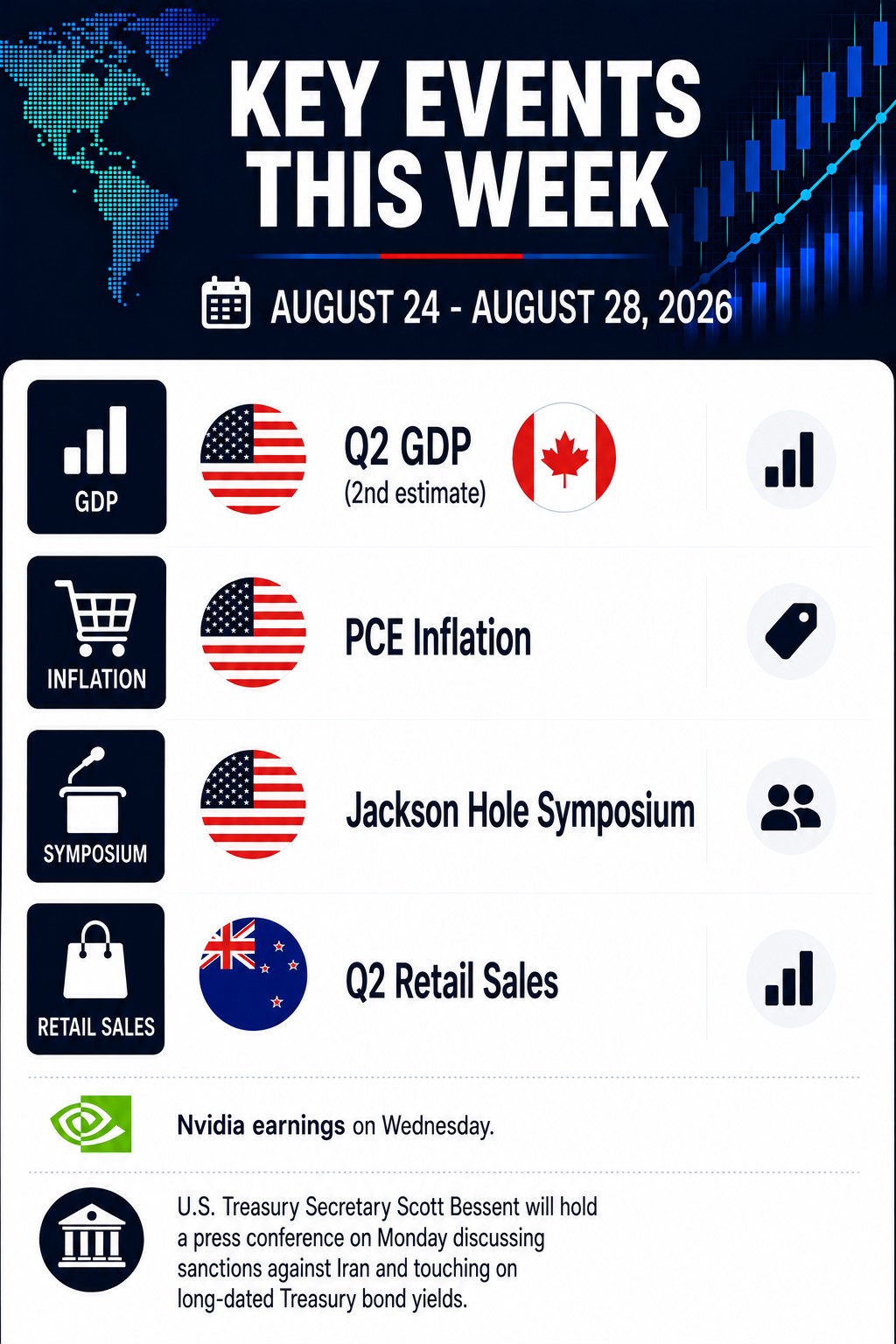
Q2 GDP from the US and Canada, PCE inflation, Q2 retail sales from New Zealand and Jackson Hole Symposium will highlight the week ahead of us. We will also get Nvidia earnings on Wednesday and U.S. Treasury Secretary Scott Bessent will hold a press conference on Monday discussing sanctions against Iran and touching on long-dated Treasury bond yields.
USD — US Dollar
MoU between US and Iran has expired and there was more aggressive rhetoric coming from both sides as there is no good will to extend the ceasefire. There were talks that Iran seized UAE oil tanker while US threatened to bomb Oman in retaliation.
US Treasury issued a statement saying that they will be increasing “by at least double, the size of liquidity support buyback operations for longer-dated nominal coupon securities (the 10-year to 20-year sector and the 20-year to 30-year sector). The current maximum size of $2 billion per operation will be at least $4 billion per operation. This change is effective September 9, 2026 and will be in effect for the remainder of this refunding quarter (through November 4, 2026). Treasury will provide more information about future buyback sizes at the next Quarterly Refunding, scheduled for November 4, 2026.”
The main idea of the move is to inject additional liquidity into the market to fight surging yields on the long-end. This was an unscheduled announcement indicating that US Treasury is not liking the level of yields in the long-end and it is signalling to the market that it is closely watching yield levels and could potentially put limit on them, which markets are already dubbing “Bessent put”. Those buybacks of longer-dated bonds will have to be financed with additional bills issuance. This will result in higher yields on the short-end and lower yields in the long-end and essentially a flatter yield curve.
FOMC minutes were not as hawkish as feared given the fact that three members dissented and voted for a rate hike. The language showed that “many” stated that interest rates will have to be higher if inflation does not come down but “most” opted for no change in rates at the July meeting. Risks to employment and growth are seen as “skewed to the downside” while risks to inflation are seen as “skewed to the upside”.
The yield on a 10y Treasury started the week at 4.69%, rose to 4.75% and finished the week at around 4.74%. The yield on 2y Treasury started the week at 4.18%, rose to 4.25% and finished the week at around 4.24%. The yield on a 30y Treasury reached new 30-year high of 5.32%and has declined after Treasury’s unscheduled buyback announcement. Spread between 2y and 10y Treasuries started the week at 52bp and finished the week at 50bp. FedWatchTool sees the probability of a no change at a September meeting at around 65% while probability of a 25bp rate hike is at around 35%. WTI prices not moved straight up finishing the week above $87. Gold surged after announced treasury buybacks and reached $4600..
This week we will have second reading of Q2 GDP, Fed’s preferred inflation measure PCE and Jackson Hole symposium. The topic for the event is Financial Innovation: Implications for Payments and Policy. It is not economic one and it will not spur a debate regarding monetary policy but it is still worth paying attention for any hints.
Important news for USD:
Wednesday:
-
GDP
-
PCE
Thursday-Friday:
-
Jackson Hole Economic Symposium
EUR — Euro
ECB Chief Economist Philip Lane stated in an interview that inflation could remain around 3% for the remainder of the year due to situation in the Middle East and added that it all depends on how the situation around US – Iran war will develop. Markets are fully pricing September rate hike and Lane distanced itself from talking about future rate hikes reiterating that the bank remains data-dependent and will make decisions on meeting-by-meeting basis.
Final CPI reading for the month of July saw both headline and core numbers unchanged from preliminary readings at 2.9% y/y and 2.5% y/y and both tick up from 2.8% y/y and 2.4% y/y in June. The report shows that services contributed most to inflation with 1.55% followed by energy with 0.94%. Increase in energy prices was the main culprit for inflation ticking higher as it printed 10.3% y/y vs 8.5% y/y the previous month. Services inflation ticked up to 3.3% y/y from 3.2% y/y in June.
Preliminary PMI data for the month of August saw further outperformance by manufacturing sector. Manufacturing rose to 52.8 from 51.9 in July beating expectations of a 51.8 print. German reading was particularly strong with a 54 print. The report notes stock building as the main reason for increase in manufacturing activity but points out that there are signs of increase in demand fir AI-related tech goods. Services sector was surprisingly unchanged at 51.7 while both German and French readings contracted. Increase in tourism spending is helping boost services sector. There were easing price pressures which will be welcomed by the ECB but the report notes that further rate hikes cannot be ruled out. Composite has ticked up to 52.1 from 52 in July.
GBP — British Pound
Payrolls change for the month of July saw economy drop another 13k jobs after losing the same amount of jobs in June. This makes it six consecutive months of job losses. The report notes that wholesale and retail sector registered the largest annual decrease in payroll employment, losing 75k jobs, while the administrative and support services sector posted the biggest increase, adding 63k jobs. June ILO unemployment rate was unchanged at 4.9%. Average earnings including bonus declined to 4.1% 3m/y from 4.4% 3m/y seen in previous three months. The discrepancy between private and public sector wages is getting more pronounced as former decreased to 3.7% 3m/y while latter increased to 6.2% 3m/y.
July inflation report saw headline CPI rise 2.9% y/y, as expected, from 2.6% y/y in June. The main cause for overall increase in prices were energy prices which led to higher household energy bills. Food inflation came down and printed 1.3% y/y, a well-behaved reading. Core CPI was unchanged at 2.6% y/y while markets were expecting a tick down to 2.5% y/y. Services eased to 3.4% y/y from 3.6% y/y the previous month. Combination of weaker payrolls data and inflation coming in as expected will not push BoE towards a rate hike and will only lower its chances.
Preliminary August PMI data saw manufacturing decline to 51.5, as expected from 51.9 while services jumped to 52.8 from 52.1 and markets expected it to decline to 51.8. Composite was thus lifted to 52.5 from 52.2 in July. The report notes that tech investment is propping the economy and at the same time job losses are moderating. US – Iran war still causes a ton of uncertainties which will keep BoE on hold but with hawkish rhetoric.
AUD — Australian Dollar
Employment report for the month of July saw economy lose 15.8k jobs vs adding 15k jobs as expected. The unemployment rate ticked up to 4.5%, highest since 2021, while markets were expecting it to stay at 4.4%. At the same time, participation rate ticked down to 66.9%. On the positive side, June reading was revised higher to 80.3k jobs with composition of jobs changing in favor of more full-time jobs. Composition of jobs in July saw economy add 15.8k full-time jobs while part-time jobs declined by 32.1k. The rise in unemployment rate will exert downward pressure on AUD but positive revisions and job composition will keep it sustained. RBA Deputy Governor Hauser stated that inflation is too high and he sees upside risks to it. He added that monetary policy will have to tighten further in order to reduce demand in the economy and bring inflation down. Hauser clarified that he does not see recession, merely a slowdown. His hawkish comments will keep AUD supported but after jobs report it may lead to another pause by RBA.
Economic data from China for the month of July were very soft. Industrial production rose 4.5% y/y after 5.3% y/y in June while retail sales rose only 0.6% y/y accentuating struggles with domestic demand. Fixed Asset Investments continued their decline and posted a fourth month of negative prints coming in at -6.7% y/y after a -5.7% y/y print the previous month while the unemployment rate rose to 5.2% from 5% in June. Official statistics department blamed weak data on bad weather but there are issues mounting in the data of the past months that are completely unrelated to the weather. These numbers are showing that economy is screaming for some stimulus.
NZD — New Zealand Dollar
July services PMI printed 50.6, a small decline from 50.9 in June, thus making it a second month in expansion. New orders led the way with inventories and activity/sales following and all above the 50 level while employment still struggles in contraction. Electronic card sales, covering almost 70% of total retail sales, rebounded in July and showed growth of 1.3% m/m and 3.4% y/y.
This week we will have Q2 retail sales data.
Important news for NZD:
Monday:
-
Retail Sales
CAD — Canadian Dollar
July inflation report saw headline CPI rise to 3% y/y from 2.8% y/y in June while markets were expecting a 2.9% y/y print. Gasoline prices surged 3.6% m/m and it reflected in an increase of transportation prices which were also impacted by the World Cup. Air transportation also saw surge in prices due to higher energy costs. Additionally, all three core measures saw increases with median printing 2% y/y, trim 1.9% y/y and common 2.7% y/y. Travel accommodations saw biggest drop in prices of 4% m/m and there was also a drop in rent prices of 0.5% m/m.
This week we will have Q2 GDP data.
Important news for CAD:
Friday:
-
GDP
JPY — Japanese Yen
Preliminary reading of Q2 GDP saw a big miss as it came in at 0.3% q/q and 1.1% y/y vs 0.5% q/q and 2% y/y as expected and down from 0.5% q/q and 1.8% y/y in the previous quarter. There was no growth in private consumption while business investment declined 1.2% q/q. The main driver of growth was external demand as exports outpaced imports. This print will complicate the picture for BoJ as with economy not as strong as expected they will not be able to easily raise rates.
Inflation report for the month of July saw prices picking up and inflation creeping back towards the 2% target as headline and ex fresh food, energy CPI both rose 1.9% y/y from 1.7% y/y in June. Core CPI, ex fresh food, printed 1.8% y/y, up from 1.6% y/y the previous month. Increase in headline number is due to higher energy prices caused by the US – Iran war. On the other hand, surge in wholesale prices to 7.2% y/y was led by higher electricity charges. Services inflation ticked up to 1.2% y/y and since this is closely followed by the BoJ it increases chances of a September rate hike.
Preliminary August PMI data saw further improvements in the economy. Manufacturing rose to 55.1 from 54.5 in July on the back of another surge in new export orders driven by relentless demand for AI related components. Employment continued to increase in sector while input costs eased but selling prices continued to increase rapidly indicating that companies are passing costs to consumers at a faster pace. Services PMI rose to 52.3 from 51.2 the previous month and thus lifted composite PMI to 53.4 from 52.7 in July.
CHF — Swiss Franc
SNB total sight deposits for the week ending August 14 came in at CHF458.8bn vs CHF462.4bn the previous week. Sixth week of declining deposits as SNB moved to the sidelines and let market dictate Swissy strength.
You can follow all economic events on the Economic Calendar page on our Website. MT server time is set to GMT+3 and if you need assistance converting MT server time to your local time you can use some of the online time converters such as WorldTimeBuddy.
Please note that this analysis should not be used as investing advice as it is only an overview of the economic events influencing the markets. Please remember that our accounts have Market Execution. Please note how Execution works during high impact news and other times of low liquidity.