
Forex Major Currencies Outlook (July 27 – July 31, 2026)
Week Ahead Summary
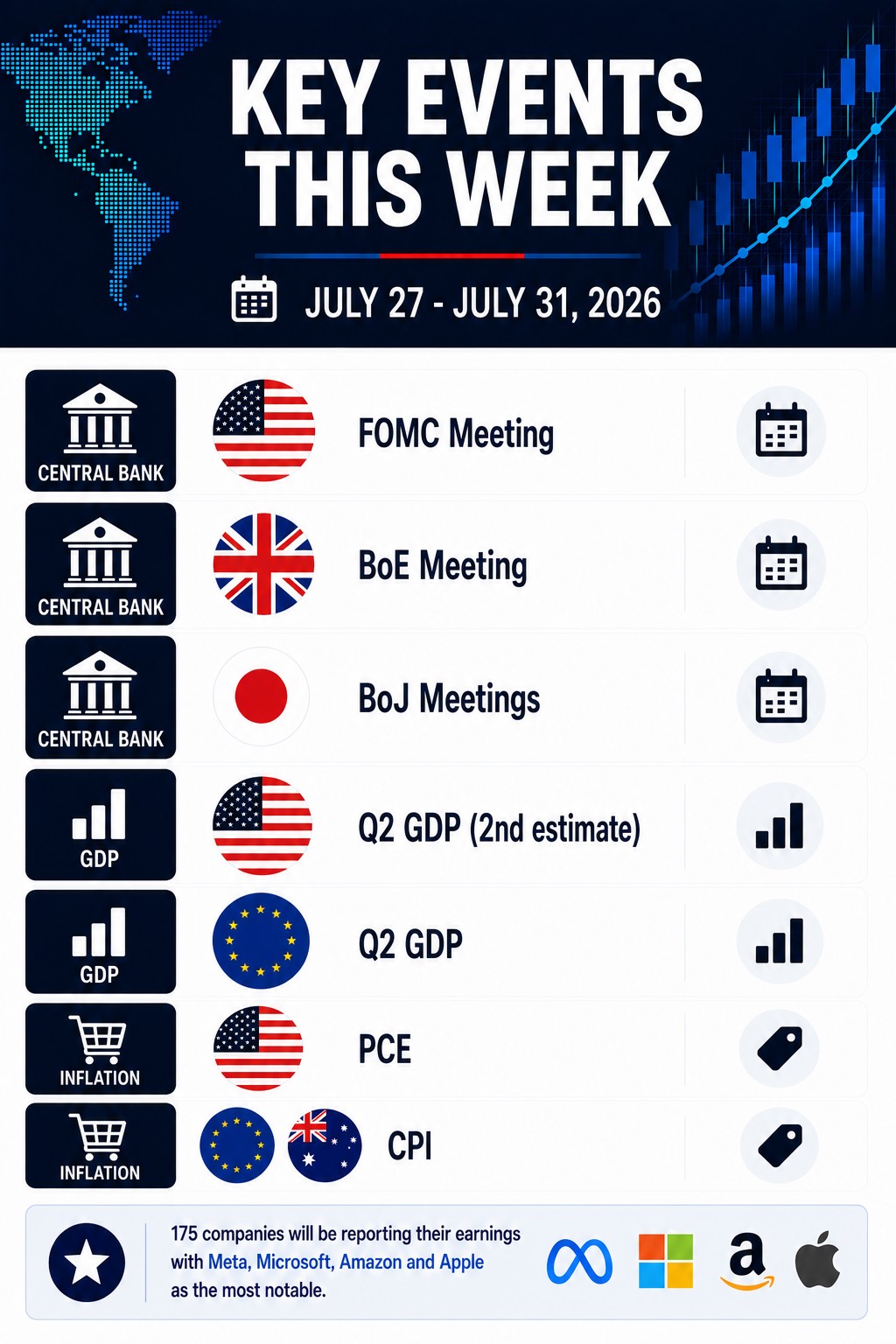
FOMC, BoE and BoJ meetings, Q2 GDP from the US and Europe, PCE and inflation data from Eurozone and Australia will highlight this massive week ahead of us. Additionally, 175 companies will be reporting their earnings with Meta, Microsoft, Amazon and Apple as the most notable.
USD — US Dollar
US – Iran war continues to intensify as strikes on Iran get more violent and Iran retaliates by attacking US bases in Bahrain, Jordan and Kuwait. Reports are coming that two vessels in Straight of Hormuz have been blown up by mines while another US serviceman died trying to disassemble enemy drone. President Trump has smacked Canada with new tariffs on dairy, alcohol and autos. New tariffs can go up to 50%. They are set on what US calls discriminating treatment of US products and should come in play on August 19.
The yield on a 10y Treasury started the week at 4.55%, rose to 4.72% and finished the week at around 4.69%. The yield on 2y Treasury started the week at 4.18%, rose to 4.38% and finished the week at around 4.33%. Spread between 2y and 10y Treasuries started the week at 37bp and finished the week at 36bp. FedWatchTool sees the probability of a no change at a July meeting at around 66% while probability of a 25bp rate hike is at around 34%. WTI finished the week at around $91 as all the escalation in Middle East pushed price up while gold remained in a range of $4000-$4200 and finished the week at around $4050.
This week we will have FOMC meeting as well as advanced reading of Q2 GDP and Fed’s preferred inflation measure PCE. Although a third of the market expects a rate hike we disagree with them and see Fed keeping rates unchanged. PCE is expected to come down given the weakerthan expected CPI and PPI prints.
Important news for USD:
Wednesday:
-
Fed Interest Rate Decision
Thursday:
-
GDP
-
PCE
EUR — Euro
ECB has left rates unchanged as widely expected with deposit rate at 2.25%. The statement shows that energy prices are broadly in line with baseline June staff projections. They see uncertainty remaining high and warn that effect of energy shock is yet to play out. The Governing Council remains in good position to navigate the uncertainty and will continue to do so on a data-dependent and meeting-by-meeting approach without pre-committing to a particular rate path.
During the press conference ECB president Lagarde dropped hawkish comments. She has clarified that risks to inflation and growth are no longer “more balanced” but instead they have shifted so we now have upward pressures to inflation and downward pressures to growth. Additionally, Lagarde stated that there was a discussion at this meeting for rate hikes. The decision to keep rates on hold was unanimous but we can see that tilt is more towards the September hike. Lagarde stated that soft inflation reading in June was a one-off thing and then added that there are no visible second-round effects. If energy prices remain elevated over the Summer we will get a new rate hike in September.
Preliminary PMI data for the month of July saw manufacturing improve to 52 from 51.4 in June as German print jumped to 52.2 while French reading barely managed to stay in expansion with a 50 print. Services managed to return to expansion with a 51.6 print with both Germany and France inching closer to expansion. The report notes first payroll rise of the year and easing of cost pressures. Composite was thus lifted to 51.9 from 50 the previous month. It is yet to be seen how the recent jump in energy prices and further escalation in US – Iran war will affect economies.
This week we will have preliminary Q2 and July inflation readings. Inflation is expected to pick up on the back of increase in energy prices.
Important news for EUR:
Thursday:
-
GDP
Friday:
- CPI
GBP — British Pound
June payrolls change saw economy shed 4k jobs after it added 3k jobs back in May. ILO unemployment rate for May was unchanged at 4.9% while markets were expecting it to tick higher to 5%. Weekly earnings eased to 4.3% 3m/y from 4.4% 3m/y the previous month while ex bonus category was unchanged at 3.4% 3m/y. There is also difference between public sector wages growing by more than 5% and private sector wages growing below 3%. Labour market remains soft but a caveat must be put as survey data is plagued with issues. On the other hand, easing and stable wages lower the chance of demand driven inflation and consequently rate hikes.
Inflation report for the month of June saw headline CPI decline to 2.6% y/y from 2.8% y/y in May while markets were seeing only a tick down to 2.7% y/y. On the other hand, core CPI remained at 2.6% y//y, with markets expecting a drop to 2.5% y/y. Monthly figures show 0.1% increase for headline but 0.3% increase for core, higher than 0.2% as expected. Services inflation remains elevated and it only ticked down to 3.6% y/y. BoE will not be fully satisfied with this report as if core proves to be stubborn they may have to consider returning to hawkish rhetoric, especially given the fact that energy prices are again on the rise.
Newly appointed Prime Minister Andy Burnham assembled his cabinet. John Healy will be the new Chancellor of the Exchequer. This comes as a bit of surprise as Shabana Mahmood was seen in that position but she will be new Interior Minister. Healy is a seasoned politician, he worked with former Chancellor in 2000s and has been a Minister himself during 2000s. This move will bring no changes to fiscal policy and investors are loving it with GBP strengthening further. Burnham announced VAT cut from energy bills in order to ease the cost of living crisis.
Preliminary June PMI numbers showed improvements across the sectors as manufacturing rose to 52.8 while both services and composite returned to expansion with 51.8 and 52.1 readings respectively. The report states that hospitality companies benefited from the FIFA World Cup and domestic holidays. Manufacturing improved back on the clients building precautionary stocks. Price pressures have eased but they remain elevated. Business optimism improved as well. It will be interesting to see how recent escalation in the Middle East will affect the economy in August print.
This week we will have BoE meeting. No change in rate is expected with a 7-2 vote. Higher energy prices make market price in rate hikes by the year end.
Important news for GBP:
Thursday:
-
BoE Interest Rate Decision
AUD — Australian Dollar
June employment report saw economy add 76.3k jobs vs 15k as expected, the most jobs since April of 2025. The unemployment rate held steady at 4.4% despite the surge in participation rate to 67% from 66.7% in May. The report shows that return of workers aged 55-64 contributed to this surge in participation. Composition of jobs was also very encouraging as the economy added 29.3k full-time jobs and 47k part-time jobs. Although RBA forecast shows the unemployment rate at 4.2% they can be very satisfied with this report and markets are now pricing in greater chance of a rate hike at the August RBA meeting. If inflation next week comes in hotter we could see a 25bp rate hike in August which would push AUD even higher.
This week we will get quarterly inflation data. RBA pays special attention to this reading and if it comes in higher than expected we should expect rate hike in August.
Important news for AUD:
Wednesday:
-
CPI
NZD — New Zealand Dollar
Q2 inflation data came in hotter than expected. Headline number saw prices rise 1.5% q/q and 4.1% y/y higher than 0.6% q/q and 3.1% y/y in Q1. The increase was led by petrol and diesel prices which rose 27.5% y/y and 71.1% y/y respectively. Non-tradeable inflation, that is inflation caused by domestic demand, rose 3.4% y/y while tradeable inflation, imported inflation, rose 2.7% y/y. RBNZ has expected inflation to print 3.9% in Q2 and then decline to 3.3% in Q3 as oil prices decline. Sectoral factor model, core CPI, came in unchanged at 2.7%. With inflation rising and coming in hotter than expected we can see RBNZ continuing with their planned rate hike at the next meeting and NZD is further gaining strength.
CAD — Canadian Dollar
June inflation report saw headline CPI slide to 2.8% y/y from 3.2% y/y, a bit bigger decline than 2.9% y/y as expected. Gasoline price declines were the main culprit for decline in inflation with monthly inflation falling 0.4% after rising 1% the previous month. BoC core measure ticked down to 2% y/y while all three core measures also declined by more than expected, median 1.9% y/y, trim 2% y/y and common down to 2.6% y/y from 2.7% y/y in May. Last week BoC left rates unchanged and this report vindicated their decision.
JPY — Japanese Yen
JPY has fallen to a new 40-year low as USDJPY crossed the 163 level. June trade deficit widened as imports surged 25.4% y/y to new record highs. Higher oil prices and weaker JPY are a deadly combination for Japan. Digging deeper into the report we see that volume of crude oil imports actually declined but due to the weaker JPY total value of oil imports was much higher. This shows that inflation is not demand driven but currency driven, meaning that further tightening by BoJ would have greater effect on total value of imports. Bloomberg reported that BoJ members expressed openness to raise rates at a faster pace than once in six months as they see weak JPY to be the big reason for inflationary pressures.
June inflation report for the entire country saw headline number rise to 1.7% y/y as expected from 1.5% y/y in May. Ex fresh food component, core inflation, also rose printing 1.6% y/y vs 1.4% y/y the previous month while ex fresh food, energy ticked down to 1.7% y/y from 1.8% y/y in May. Headline inflation stayed below 2% every month in 2026 and is pushed down by government subsidies intended to keep pressures from US – Iran war subdued. BoJ will use this data at their next week’s meeting and will see no need to hike rates.
Preliminary July PMI data saw manufacturing print tick down to 54.7, still a very healthy print boosted by a sharp increase in output index which moved to 56.1. Services PMI declined to 51.9 from 52.2 in June as new export orders continued to decline. Composite managed to improve 53.1from 52.8 the previous month.
This week we will have BoJ meeting. Despite all the talk and calls for rate hikes we do not expect the bank to deliver one at this meeting and will instead keep rates unchanged.
Important news for JPY:
Friday:
-
BoJ Interest Rate Decision
CHF — Swiss Franc
SNB total sight deposits for the week ending July 17 came in at CHF469.4bn vs CHF471.3bn the previous week. This is the second consecutive week of falling deposits with SNB stopping to pump in liquidity and keeping deposits at the levels last seen one month ago.
You can follow all economic events on the Economic Calendar page on our Website. MT server time is set to GMT+3 and if you need assistance converting MT server time to your local time you can use some of the online time converters such as WorldTimeBuddy.
Please note that this analysis should not be used as investing advice as it is only an overview of the economic events influencing the markets. Please remember that our accounts have Market Execution. Please note how Execution works during high impact news and other times of low liquidity.